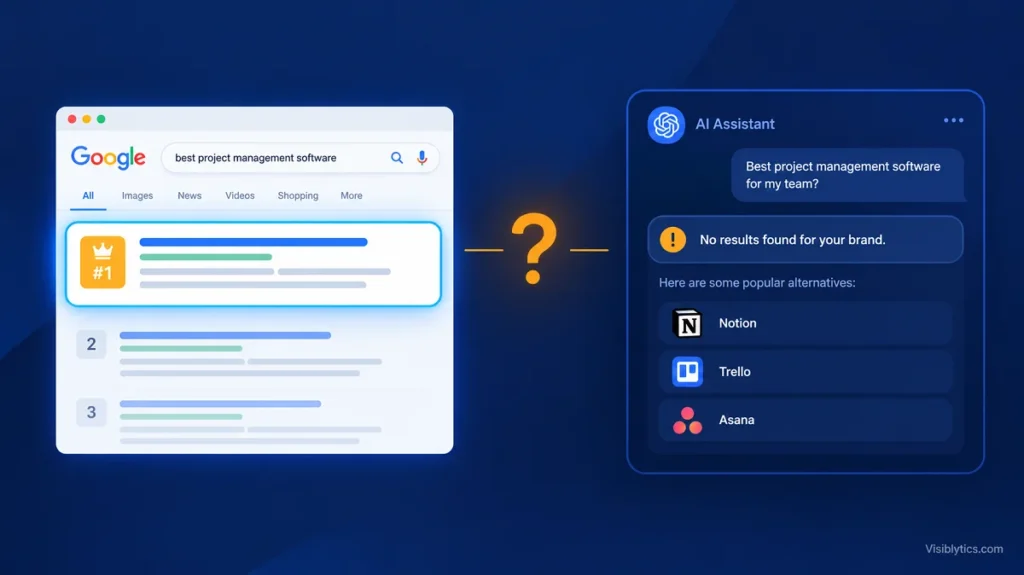
Your category keywords sit on page one. Organic sessions are flat-to-up. Then a prospect mentions on a discovery call that they asked ChatGPT for “the best vendors for [your category]” and shortlisted three of your competitors. You were not in the answer. Neither was your pricing, your case studies, or your positioning.
This is the pattern showing up in more B2B pipelines: a strong Google ranking and a total absence from AI answers can coexist. The two systems reward overlapping but different signals, and most SEO retainers were scoped before anyone was measuring citations. If you are a founder, CMO, or technical lead with an active search budget, the question is not whether this matters. It is where the gap comes from and what it costs to close it.
Below is the diagnosis, the audit you can run this week, and a clear-eyed view of what professional help should deliver (and what it should never promise).
The AI Search Blindspot: Why High-Ranking Brands Are Invisible to LLMs
A page-one ranking tells Google that one URL deserves a slot for one query. An AI answer is built differently: the system assembles a response from several sources and names the brands it is most confident about. Your URL can be excellent and still lose, because the system is not only asking “which page is best?” It is asking “which entities are consistently associated with this topic across sources I trust?”
That is why brands with modest rankings but heavy third-party presence (analyst roundups, community discussions, podcast appearances, comparison pages) often get named ahead of brands with better on-site SEO. Three patterns we see repeatedly:
- Rankings without corroboration. Your own site says you are the leader. Nobody else says it.
- Content that answers, but cannot be extracted. Long narrative pages with the key claim buried in paragraph nine.
- Access problems nobody noticed. A security plugin or a CDN rule quietly blocked AI crawlers months ago.
None of these show up in a rank tracker. That is the blindspot.
How LLMs and Answer Engines Select Sources (RAG Architecture, Vector Embeddings & Entity Authority)
Most answer engines that cite sources use a retrieval step before they write anything. In simplified form:
- Query expansion. One prompt is split into several sub-queries (“best [category] tools,” “[category] pricing,” “[category] vs alternatives”).
- Retrieval. Documents or passages are pulled from a search index, often a blend of a conventional index and a vector index, where text is stored as embeddings and matched by meaning rather than exact keywords.
- Passage selection. Retrieved chunks are scored for relevance and trust. Short, self-contained passages with a clear claim and a clear subject tend to survive this step.
- Synthesis and attribution. The answer is written, and sources that supported specific claims get cited.
Entity authority sits across all four steps. If a system cannot confidently resolve “your brand” to a single, well-described entity (what you do, who you serve, how you differ), it has little reason to include you in a recommendation list. It does not need to “like” you. It needs to be able to verify you.
Two practical consequences:
- Search intent still matters. Pages that match the decision-stage intent behind a prompt are the ones that get retrieved. If you need a refresher on how we map queries to page types, our search intent guide covers it so we do not repeat it here.
- Retrieval is not uniform. Perplexity leans heavily on live retrieval and shows its sources. ChatGPT with browsing does something similar when it searches; without it, answers lean on training data, which lags. Google AI Overviews draws from Google’s own index, so classic technical health still applies. Audit each surface separately.
4 Reasons Your Competitor Is Cited in ChatGPT While You Are Ignored
1. Missing Knowledge Graph & Entity Disambiguation
If your brand name is generic, shared with another company, or described differently on every profile you own, retrieval systems struggle to attach facts to you. Symptoms:
- No Knowledge Panel for brand queries, or a panel showing the wrong company
- Inconsistent one-line descriptions across your homepage, LinkedIn, Crunchbase, and directories
- No Wikidata item (where you meet notability standards) and no
Organizationschema withsameAslinks tying your properties together
A minimal starting point:
{
  "@context": "https://schema.org",
  "@type": "Organization",
  "name": "Your Brand",
  "url": "https://www.yourbrand.com/",
  "description": "One consistent sentence describing what you do and for whom.",
  "sameAs": [
    "https://www.linkedin.com/company/yourbrand",
    "https://www.crunchbase.com/organization/yourbrand",
    "https://www.wikidata.org/wiki/Qxxxxxxx"
  ]
}
If your problem is deeper than markup (merged entities, wrong facts, a disappearing panel), that is entity work rather than content work, and it is what our entity SEO services are scoped around.
2. Lack of Third-Party Consensus & Authoritative Co-Occurrences
Answer engines are cautious about claims that only the brand itself makes. Your competitor is likely named alongside the category in places you are not:
- Listicles and comparison posts on industry publications
- G2, Capterra, or niche directory profiles with substantive reviews
- Podcast transcripts, conference speaker pages, and webinar recaps
- Reddit and community threads where practitioners recommend vendors
Unlinked mentions count here. A named mention next to your category, repeated across independent sources, builds the association even without a backlink. Count how many independent domains mention your brand next to your core category phrase, then do the same for the competitor being cited. The gap is usually double digits, not single.
3. Unstructured Content Architecture That LLM Crawlers Skip
Passage-level retrieval rewards pages that are easy to lift from. Common failures:
- Key facts (pricing ranges, supported integrations, who it is for) hidden in images, PDFs, tabs, or accordions that need JavaScript to render
- No direct-answer block under headings; the answer arrives after 300 words of build-up
- Comparison content written as marketing prose instead of a table with named attributes
- Client-side rendered pages where the raw HTML response is nearly empty
You can test the last one in two minutes: fetch the page with curl or view source in Chrome DevTools and check whether your core claims exist in the initial HTML.
4. Restrictive Robots.txt Rules Blocking GPTBot and PerplexityBot
This is the cheapest fix and the one most often missed. Many sites inherited blanket bot rules from a security tool, a CMS preset, or a legal request in 2023. Check yourdomain.com/robots.txt for lines like:
User-agent: GPTBot
Disallow: /

User-agent: PerplexityBot
Disallow: /
Also check the user agents tied to search-style retrieval (for example OAI-SearchBot and ChatGPT-User for OpenAI) separately from training crawlers; blocking training while allowing search retrieval is a legitimate policy choice, but blocking everything is a visibility decision whether you meant it or not. Then check your CDN or WAF: a firewall rule can return a 403 to these bots even when robots.txt allows them. Server logs are the only reliable confirmation.
Auditing Your Current Brand Footprint Across Leading AI Search Engines
Before you spend money, take a baseline. Run each prompt below in ChatGPT (with search on), Perplexity, and Google AI Overviews (logged out, in a clean browser profile). Record whether you are named, cited as a source, or absent, and who appears instead.
| Prompt type | Test prompt (replace brackets) | What you are checking |
|---|---|---|
| Category shortlist | “What are the best [category] providers for [buyer type]?” | Are you named in the top 5? |
| Comparison | “[Your brand] vs [competitor]: which is better for [use case]?” | Is the description of you accurate? |
| Pricing | “How much does [service] cost for a [company size] business?” | Is your pricing page cited? |
| Problem-led | “How do I fix [specific problem your service solves]?” | Do you appear as a source or only competitors? |
| Brand check | “What does [your brand] do and who is it for?” | Entity accuracy: founders, HQ, offerings |
| Alternatives | “Alternatives to [competitor]” | Are you in the alternatives set? |
Run each prompt three times on different days, because outputs vary. Score each result: 2 = named and cited, 1 = named without citation, 0 = absent. A baseline under 30% of the maximum on category and problem-led prompts usually points to consensus and structure problems rather than a technical block.
Then add the diagnostics that prompts cannot show:
- GA4 referral traffic from
chatgpt.com,perplexity.ai, and similar sources. Low numbers are expected, but zero across months is informative. - Server log review for AI crawler user agents and their response codes (200 vs 403 vs 5xx).
- Screaming Frog with a custom user agent to see what these bots receive, plus JavaScript rendering off to approximate raw HTML.
- Ahrefs or Semrush brand mention reports to count independent co-occurrences with your category terms.
- Google Search Console to confirm that the pages you want cited are indexed and not sitting in “Crawled, currently not indexed.”
How Professional AI Visibility Services Build Verified LLM Citations
If the audit shows gaps in entity clarity, third-party consensus, and extractable content at the same time, this is rarely a weekend project. A credible partner works in a defined sequence, and you should expect deliverables you can inspect:
- Citation baseline report: your prompt set, scores by engine, and competitor citation share
- Access and crawl fixes: robots.txt, WAF rules, rendering checks, sitemap hygiene
- Entity build-out:
OrganizationandPersonschema, consistent descriptors, registry and profile cleanup - Citable assets: comparison tables, original data, pricing explainers, and direct-answer blocks on commercial pages
- Consensus building: digital PR, expert commentary, and community presence aimed at independent mentions
- Monthly monitoring: repeat prompt tests, mention tracking, and a short change log
What it typically costs
Ranges vary by competition and starting point, but these are realistic benchmarks for senior-led work:
| Package | Typical range | What should be included |
|---|---|---|
| One-off AI visibility audit | $500 to $1500 | Prompt baseline, crawl/access review, entity audit, prioritized fix list |
| Ongoing AI visibility retainer | $1,000 to $3,000/mo | Implementation, content assets, consensus building, monthly reporting |
| Monitoring-only (tools plus reporting) | $300 to $1,000/mo | Prompt tracking and mention alerts; no implementation |
If a quote is far below these ranges for ongoing work, ask where the hours come from.
How to spot fake AI ranking claims
No one controls what a model says. Treat these as red flags:
- “Guaranteed #1 in ChatGPT” or any fixed-position promise
- Screenshots of a single prompt result presented as proof (outputs vary by session, location, and day)
- No documented prompt set or methodology you can rerun yourself
- Reports that list “AI visibility score” with no explanation of how it is calculated
- Tactics that rely on mass-generated pages or hidden text aimed at crawlers
- No mention of entity work, third-party mentions, or access checks
A better question for any vendor: “Show me the prompts, the engines, the dates, and the competitor baseline.”
Next step
If you want the baseline run for you, with the entity, access, and structure issues found and prioritized, our AI visibility services to get your brand cited in AI search engines start with exactly that audit, led directly by a senior specialist rather than handed down a chain of account managers. You leave with a prioritized fix list whether or not we work together afterward.