Your knowledge panel shows the wrong founding date. Your LinkedIn says “SEO agency” but Google describes you as a “search tool.” A journalist covered your rebrand six months ago but AI systems still introduce you by your old company name. You have updated your website. Nothing has changed in how you appear.
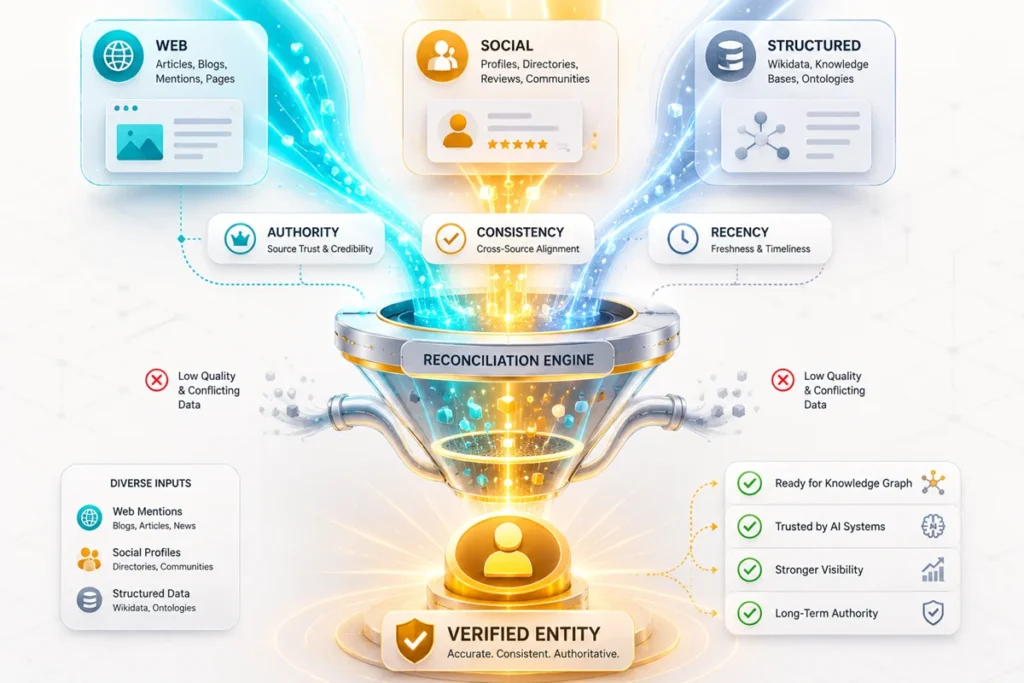
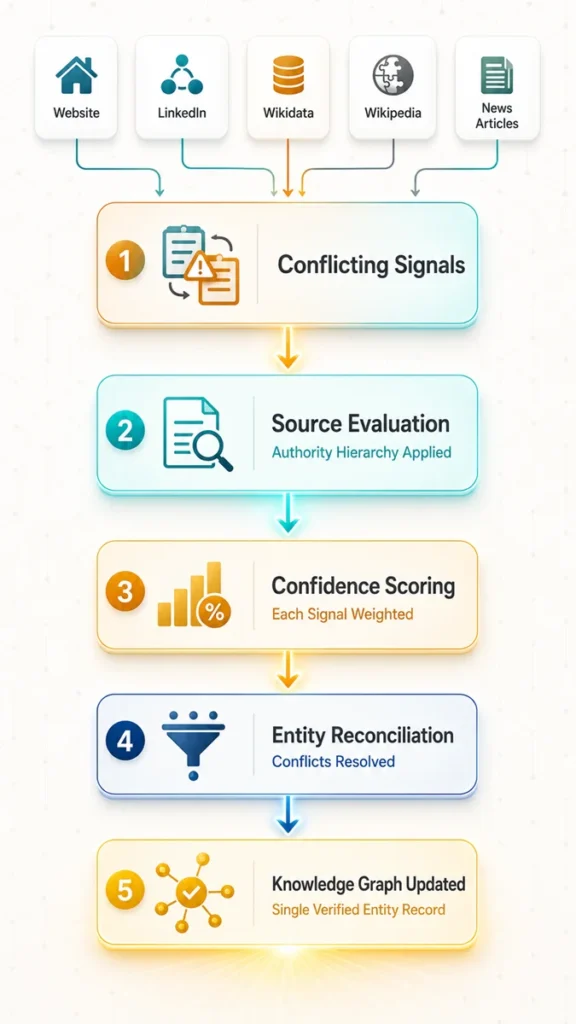
This is entity reconciliation at work, or rather, entity reconciliation that has not yet resolved in your favor. When search engines encounter conflicting information about the same entity across multiple sources, they run a process to decide which version is correct. That process takes time, follows a specific hierarchy of source authority, and can stall when the signals are too evenly split to resolve cleanly.
Understanding how reconciliation works is what separates entity problems that fix in weeks from ones that persist for months. More importantly, it is what tells you exactly where to intervene to resolve a conflict as quickly as possible.
What Is Entity Reconciliation?
Entity reconciliation is the mechanism search engines use to determine the single most accurate version of an entity when multiple sources present conflicting information. It is distinct from disambiguation, and the difference matters.
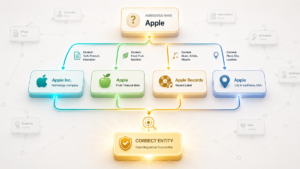
Disambiguation answers the question: which entity does this name refer to? When someone searches “Mercury,” disambiguation determines whether they mean the planet, the element, the car brand, or the musician. It is the process of resolving ambiguity about which entity a term points to.
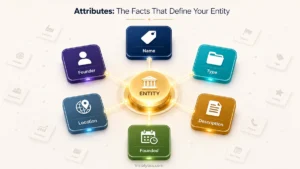
Reconciliation answers a different question: given that the entity has been identified, which version of its attributes and relationships is correct? When search engines find that Visiblytics is described as an “SEO platform” on one source, an “AI Visibility consultancy” on another, and a “search intelligence tool” on a third, reconciliation is what determines which description becomes the authoritative one stored in the knowledge graph.
| Disambiguation | Reconciliation |
|---|---|
| Which entity is this? | Which version of this entity is correct? |
| Triggered by ambiguous names | Triggered by conflicting attributes or relationships |
| Resolves identity confusion | Resolves information conflicts |
| “Is this Apple the company or apple the fruit?” | “Was Apple founded in 1976 or 1977?” |
| Solved by context signals | Solved by source authority hierarchy |
Both processes run continuously as search engines crawl and re-crawl the web. Both affect how confidently your entity is represented in search results, knowledge panels, and AI-generated answers. This article covers reconciliation specifically. The full treatment of disambiguation is in the Entity Disambiguation guide.
What Triggers Entity Reconciliation?
Reconciliation is triggered whenever a search engine encounters information about your entity that conflicts with what it already knows. The most common triggers are:
Name variations. Your organization is called “Visiblytics” on your website, “Visiblytics SEO” on LinkedIn, and “visiblytics.com” in a directory. Each version is a different signal for what should be the same entity name. The search engine has to decide which version is authoritative.
Conflicting founding dates. Your schema markup says your company was founded in 2023. A press mention says 2024. Your Wikidata entry has no date at all. Three signals pointing in different directions on the same attribute.
Changed URLs. Your site moved from http to https, or from one domain to another. Old links and mentions point to the previous URL. Crawlers encounter two URLs associated with the same entity and need to determine which is current.
Rebranding. Your company was called “X Agency” and is now called “Visiblytics.” External sources still reference the old name. The search engine must reconcile whether these are the same entity or two separate ones.
Role or attribution changes. A person who was listed as “Co-Founder” on your site is now listed as “Founder” following a restructuring. Some external sources still use the old attribution.
Acquired or merged entities. Your company acquired another company. The acquired company has its own entity record in the knowledge graph. The search engine needs to determine how to represent the relationship between the two records.
Conflicting category classification. Your schema says @type: ProfessionalService. A major directory has listed you under “Software.” A third source describes you as a “media company.” Three different category signals for the same entity.
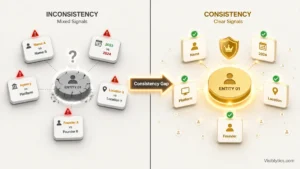
Each of these triggers does not create an immediate problem. It creates a reconciliation task that the search engine resolves over time, with the resolution quality depending entirely on which signals are clearest and which sources carry the most authority.
How Search Engines Choose the Winning Signal
When signals conflict, search engines do not weigh them equally. They apply a source authority hierarchy, assigning higher confidence to signals from sources they already consider more reliable. Understanding this hierarchy is the most practical knowledge in this article, because it tells you exactly where to fix a conflict to resolve it fastest.
While search engines do not publish an official hierarchy, they appear to assign different levels of confidence to different source types. In practice, the following order reflects how these sources are generally understood to influence entity reconciliation:
1. Your entity homepage with schema markup. A clearly structured entity page with Organization or Person schema is the highest-authority self-reported source. When your entity homepage explicitly states an attribute in machine-readable schema, it is the strongest signal you directly control. The entity homepage guide covers how to build this correctly.
2. Wikipedia. Where a Wikipedia article exists for your entity, it carries extremely high authority. Wikipedia’s editorial standards, its citation requirements, and its established position in knowledge graph systems make it one of the most trusted sources for entity attribute verification. This is why a Wikipedia article that contains outdated or incorrect information about your entity is a high-priority fix.
3. Wikidata. Wikidata is a structured, machine-readable knowledge base that feeds directly into multiple knowledge graph systems. A Wikidata entry stating your founding date, founder, and entity type carries significant authority because it is a structured, third-party, independently-maintained source. When your Wikidata entry contradicts your schema markup, the search engine has a genuine conflict between two high-authority sources, which is one of the harder reconciliation problems to resolve.
4. Trusted third-party publications. Coverage in recognized publications that the search engine already has strong entity records for carries meaningful authority. A Forbes article naming your founder, a TechCrunch piece describing your company category, or an industry publication citing your founding year are all high-authority signals for those specific attributes.
5. Consistent social profiles. LinkedIn, Twitter/X, and other major platforms contribute corroboration signals. Their authority comes primarily from consistency: a LinkedIn company page that matches your schema exactly reinforces the signal. One that contradicts it introduces a reconciliation conflict.
6. Directories and structured listings. Industry directories, government business registries, and structured listing sites carry moderate authority. They are more useful for corroboration than for correction: they confirm what higher-authority sources say rather than overriding them.
7. General web mentions. Unstructured mentions of your entity across the broader web carry the lowest individual authority, but their value comes from volume and consistency. Many independent sources using the same name, description, and attributes provides strong cumulative corroboration even when each individual mention is low-authority.
The practical rule: When you need to correct a conflicting signal, fix it at the highest-authority sources first. Update your entity homepage and schema. Then update or correct your Wikidata entry. Then address Wikipedia if applicable. Then update social profiles and directories. Fixing only a low-authority source while a high-authority source still carries the old information will not resolve the reconciliation conflict.
Entity Merging and Entity Splitting
Two specific reconciliation outcomes deserve their own explanation because they are the most disorienting when they happen and the least understood when brands try to fix them.
Entity Merging
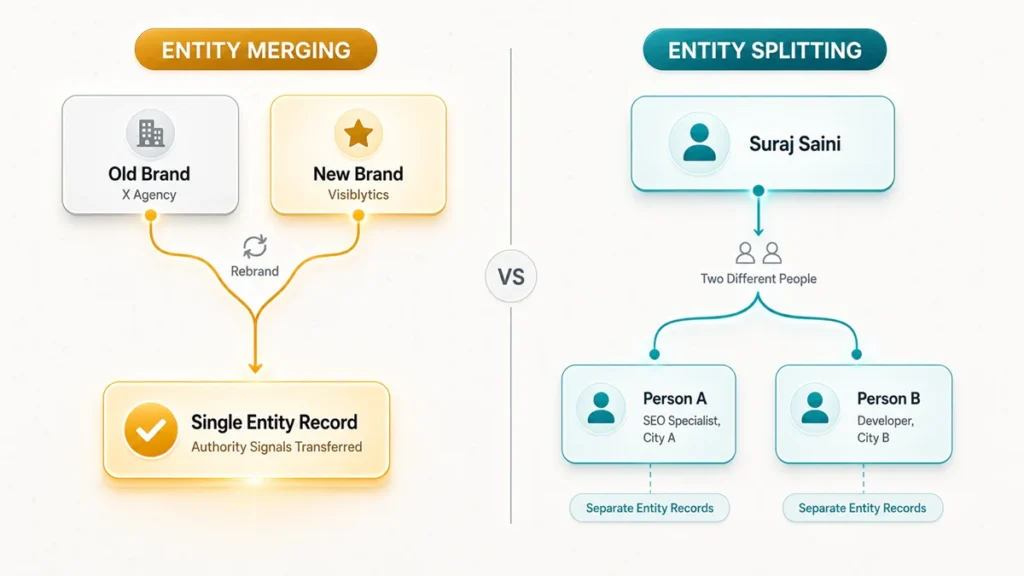
Entity merging happens when a search engine determines that two separate entity records in its knowledge graph actually refer to the same real-world entity and collapses them into one.
This commonly happens after a rebrand. “X Agency” operated for three years and has its own entity record: mentions, backlinks, a directory presence, possibly a Wikipedia stub. It rebrands as “Visiblytics.” For a period, the search engine has two records: one for X Agency and one for Visiblytics. As corroboration accumulates (redirects, sameAs references, mentions of “formerly X Agency, now Visiblytics”), the system eventually merges the two records.
Merging is generally a positive outcome: the authority signals from the old entity transfer to the new one. The risk is during the transition period, when the entity exists in an uncertain state with split signals and lower overall confidence.
How to accelerate merging:
- Implement 301 redirects from all old URLs to new ones
- Add
sameAsin your new entity’s schema pointing to any archived presence of the old entity - Update your entity homepage to explicitly state the former name (“formerly X Agency”)
- Update Wikidata to reflect the name change with a “formerly known as” relationship
- Earn mentions that explicitly connect the old and new names (“X Agency, now rebranded as Visiblytics”)
Entity Splitting
Entity splitting is the opposite: a search engine determines that what it has been treating as one entity is actually two separate entities and divides the record.
This happens most commonly with people who share a name. If two professionals named “Suraj Saini” both have an online presence, a search engine may initially conflate them into one entity record, then split them as it accumulates enough distinguishing signals to be confident they are different people.
It also happens with companies that have common generic names or that operate in multiple distinct markets under the same name.
How to help splitting resolve correctly:
- Ensure your entity’s distinguishing attributes are clearly stated: your specific location, your founding date, your specific area of work
- Use schema properties that differentiate your entity:
jobTitle,worksFor,foundingDate, geographic information - Pursue external mentions that include specific distinguishing details, not just your name
Reconciliation During Rebranding
Rebranding is the highest-stakes reconciliation scenario most businesses will face. It is worth covering in its own section because the mistakes made during rebrands are predictable and avoidable.
When a company rebrands, it is asking the search engine’s reconciliation system to do something complex: recognize that the old entity and the new entity are the same thing, transfer the authority signals from the old name to the new name, and update the knowledge graph representation to reflect the new attributes.
What happens if you do it wrong: You change your name and update your homepage but leave dozens of external mentions, directory listings, and social profiles with the old name. The search engine now has high-authority signals for the new name (your entity homepage) and high-volume signals for the old name (all the external sources). Reconciliation stalls because the signals are split. Your entity confidence score drops during the transition. Knowledge panel information may show incorrect or mixed data. AI systems may cite you under the wrong name or not at all.
What happens if you do it right: You update your entity homepage and schema first. You update Wikidata immediately. You update social profiles and major directories. You implement 301 redirects. You publish content that explicitly bridges the old and new names. You earn at least a few mentions from credible sources that acknowledge the rebrand. The reconciliation process has a clear signal to work with, and the transition resolves faster.
Realistic timeline: I cannot give a verified universal timeline for how long rebrand reconciliation takes, since this depends on many factors including your entity’s existing authority, the volume of conflicting signals, and how quickly you update external sources. As a general pattern, entities with strong pre-rebrand authority and fast, thorough signal updating tend to resolve faster than those that update piecemeal over months.
How AI Systems Handle Reconciliation
AI systems handle entity reconciliation differently from traditional search engines, and the difference matters for how you manage conflicts.
Training data cutoff problem. Large language models like ChatGPT and Claude are trained on data up to a specific cutoff date. If your rebrand or name change happened after that cutoff, the model’s training data contains only the old name. Even if the retrieval layer (where the model searches the web for current information) finds the new name, there can be a conflict between what the model “knows” from training and what it retrieves live. This can result in AI systems referring to your entity by its old name or mixing old and new attributes in the same answer.
Retrieval-based systems. Systems like Perplexity that rely heavily on live retrieval are more responsive to current entity signals than purely training-based systems. If your entity homepage and high-authority sources consistently present the new name and attributes, retrieval-based systems will adapt faster. The full mechanics of how AI retrieval works are covered in the LLM SEO guide.
Structured knowledge sources. AI systems that draw from Wikidata and similar structured knowledge bases during retrieval are subject to whatever those bases currently say about your entity. This is why Wikidata is a high-priority update target during any entity reconciliation effort: it feeds AI systems directly, not just traditional search.
Practical implication: When managing entity reconciliation for AI visibility, prioritize updating structured knowledge sources (Wikidata first), then your entity homepage and schema, then social profiles. These are the sources AI retrieval systems weight most heavily. Unstructured web mentions, while useful for traditional search reconciliation, have less predictable influence on AI system behavior.
How to Audit Your Entity for Reconciliation Problems
Before you can fix reconciliation conflicts, you need to find them. Here is a systematic audit process.
Step 1: Search your entity name in Google. Search your exact brand name. Search common variations (with and without “SEO,” “Agency,” “Ltd,” “.com”). Look at what appears. Are the results consistent? Does Google show one clear entity or mixed signals? Does a knowledge panel appear, and if so, does the information match what your entity homepage says?
Step 2: Check your knowledge panel for errors. If a knowledge panel exists, read every piece of information it displays. Incorrect founding date, wrong category, outdated description, missing or wrong founder attribution: each of these is a symptom of a reconciliation conflict that has partially resolved in the wrong direction.
Step 3: Audit your top external sources. Search your brand name in inverted commas and review the top 20-30 results. Note every version of your entity name you find. Note every description of what you do. Note every attribution of people to your organization. List every inconsistency.
Step 4: Check Wikidata. Search Wikidata for your entity. If an entry exists, check every attribute against your entity homepage. If an entry does not exist, evaluate whether your entity meets Wikidata’s notability requirements before creating one.
Step 5: Check your schema. Run your entity homepage and author pages through the Structured Data Testing Tool. Confirm that every attribute in your schema matches exactly what your entity homepage says in prose. A schema error or mismatch is a high-priority reconciliation conflict because schema is your highest-authority self-reported signal.
Step 6: List all active profiles. Make a complete list of every platform where your entity has a profile: LinkedIn, Twitter/X, Facebook, YouTube, industry directories, Google Business Profile if applicable. For each one, check the entity name, description, category, and any attributed people. Every inconsistency is a reconciliation conflict.
How to Fix Conflicting Entity Signals
Once you have identified your conflicts, fix them in order of source authority, highest first.
Fix 1: Entity homepage and schema. Update your entity homepage so every attribute is exactly correct. Then update your schema to match. Run the Schema Markup Generator if you need to rebuild schema from scratch. Validate with the Structured Data Testing Tool. This is always the first fix, because it is your highest-authority self-reported signal.
Fix 2: Wikidata. If your Wikidata entry contains incorrect or outdated information, update it using reliable, verifiable sources wherever possible. Because Wikidata is community-maintained, unsupported edits may be challenged or reverted. If no entry exists, consider creating one only when your entity meets Wikidata’s notability requirements and you can provide appropriate references.
Fix 3: Wikipedia. If a Wikipedia article about your entity contains incorrect information, you can request corrections through Wikipedia’s talk page process. Direct editing is subject to editorial review, and I would recommend against editing Wikipedia articles about your own entity without understanding their conflict of interest guidelines.
Fix 4: Social profiles. Update LinkedIn, Twitter/X, and other major profiles to exactly match your entity homepage. Same name, same description, same attributed people, same category.
Fix 5: Directories. Work through your list of directory presences systematically. Update each one to match your entity homepage. For old profiles that cannot be updated or deleted, consider whether they are creating meaningful conflict or simply carrying an outdated signal that will be outweighed by higher-authority sources over time.
Fix 6: Pursue corrective mentions. For rebrands or significant attribute changes, actively pursue a few mentions from credible sources that state the current, correct information. A TechCrunch piece, an industry newsletter, or a recognized publication that references your entity with correct current attributes provides high-authority external corroboration that accelerates reconciliation.
On timing: Make all changes to your entity homepage and schema first, before updating external sources. The entity homepage is the source of record. External sources should then be updated to match it, not the other way around. Updating external sources before updating your own entity homepage creates a temporary state where your highest-authority source contradicts your corrective signals.
Common Entity Reconciliation Mistakes
Changing brand name without updating external sources. Updating your homepage and ignoring the 40 external sources that still carry the old name is the most common rebrand mistake. The search engine now has a split signal: one high-authority source says new name, dozens of lower-authority sources say old name. Reconciliation stalls.
Leaving old profiles active. An old Twitter profile, a dormant LinkedIn page, a directory listing for a former business address: each active profile carrying outdated information is a live reconciliation conflict. Deactivate or update profiles you cannot fully maintain with current information.
Multiple websites for the same entity. Running a blog on one domain, a portfolio on another, and a business site on a third, all for the same entity, creates three separate sources that the search engine has to reconcile. Consolidate where possible. Where consolidation is not possible, use canonical signals and sameAs references to explicitly connect the sources.
Fixing only visible problems. A knowledge panel showing the wrong founding date is a visible symptom. The actual problem is a conflict between sources. Changing only the knowledge panel display (through the “Suggest an edit” feature) without fixing the underlying conflicting source is a temporary fix that may not hold.
Inconsistent schema across page types. Organization schema on your homepage says one thing. Person schema on your author page contradicts it. Article schema on your blog posts references an old URL. Internal schema conflicts are reconciliation problems that exist entirely within your own domain and are entirely within your control to fix.
Treating reconciliation as a one-time fix. Entity information changes over time: people change roles, companies change focus, products get renamed. Every change creates a new reconciliation task. Treating entity maintenance as an ongoing practice rather than a one-time setup is what keeps reconciliation conflicts from accumulating.
Entity Reconciliation Checklist
Audit:
- Searched brand name and all known variations in Google
- Checked knowledge panel for accuracy (if one exists)
- Reviewed top 30 external search results for name and description variations
- Checked Wikidata entry for accuracy and completeness
- Validated schema on entity homepage and author pages
- Listed all active external profiles and checked each for consistency
Fix (in order):
- Entity homepage updated to authoritative, correct information
- Schema updated to match entity homepage exactly
- Wikidata entry updated or created
- Social profiles updated to match entity homepage
- Directories updated or flagged for ongoing maintenance
- 301 redirects implemented if URLs have changed
Rebranding specifically:
- Former name explicitly mentioned on entity homepage (“formerly [old name]”)
- sameAs in schema connecting old and new entity presence where applicable
- Wikidata updated with “formerly known as” relationship
- At least one credible external mention bridging old and new names
Compare your entity homepage, schema markup, author pages and social profiles side by side. Every core attribute should match exactly.
❓ Frequently Asked Questions
What is entity reconciliation in SEO?
Entity reconciliation is the process by which search engines resolve conflicts between different or contradictory information about the same entity across multiple sources. When your brand name, description, founding date, or other attributes appear inconsistently across your website, schema markup, social profiles, Wikidata, and third-party mentions, reconciliation is the mechanism that determines which version becomes the authoritative representation stored in the knowledge graph.
How is entity reconciliation different from disambiguation?
Disambiguation resolves ambiguity about which entity a name refers to. Reconciliation resolves conflicts about what is true about an already-identified entity. Disambiguation asks “which entity is this?” Reconciliation asks “which version of this entity is correct?” Full detail on disambiguation is in the Entity Disambiguation guide.
How long does entity reconciliation take?
I cannot give a verified universal timeline, and I would be cautious of any source that states one with precision. It depends on the strength of your conflicting signals, the authority of the sources on each side of the conflict, and how thoroughly you update your sources. As a general pattern, conflicts involving high-authority sources on both sides (schema vs Wikidata, for example) take longer to resolve than conflicts where one side is clearly higher-authority. Acting at the highest-authority sources first and making changes comprehensively rather than piecemeal tends to produce faster resolution.
What happens to my entity during rebranding?
During a rebrand, your entity exists in a transitional state where high-authority new-name signals compete with accumulated old-name signals. The reconciliation process works to merge these into a single updated entity record. The speed of resolution depends on how quickly and completely you update your signals, starting with your entity homepage and schema, then Wikidata, then social profiles and directories. The Rebranding section above covers the full process.
Can you speed up entity reconciliation?
You cannot force a search engine to reconcile faster, but you can remove the obstacles that slow reconciliation down. Fixing conflicts at the highest-authority sources first, being comprehensive rather than selective about which external sources you update, and earning credible mentions that confirm your current entity information all help. What does not help is fixing only the visible symptom (a knowledge panel error) without addressing the underlying conflicting signal.
Does AI reconcile entities differently from search engines?
Yes, in important ways. AI systems trained on historical data carry the version of your entity that existed at their training cutoff, which can conflict with live retrieval results. Retrieval-based AI systems like Perplexity are more responsive to current signals than purely training-based systems. Wikidata is particularly important for AI reconciliation because it feeds structured knowledge directly into many AI retrieval systems. Full detail on how AI systems process entity information is in the LLM SEO guide.
What is entity merging and should I be concerned about it?
Entity merging happens when a search engine determines that two separate entity records (for example, your company under its old name and its new name) actually refer to the same entity and consolidates them. This is generally a positive outcome: authority signals from the old entity record transfer to the new one. The concern is during the transition period, when split signals can reduce entity confidence. The Entity Merging section above explains how to accelerate this process.
Entity Reconciliation Is Ongoing, Not a One-Time Fix
Every time your entity changes, a reconciliation task is created. Every inconsistency across your sources is an open reconciliation conflict. The brands that maintain strong entity clarity over time are the ones that treat entity maintenance as a continuous practice, not a launch-day checklist.
The practical approach: any time a meaningful change happens to your entity (new role, new name, new focus, new URL), start at your entity homepage, update it first, then work outward through the source authority hierarchy until every surface reflects the same accurate information.
That discipline is what keeps your entity representation clean, confident, and consistently citable by both search engines and AI systems.
For the full foundation of how entities work and how to build them correctly from the start, the Entity SEO guide covers the complete framework. For how search engines initially identify entities before reconciliation begins, the Named Entity Recognition guide covers that process in depth.