
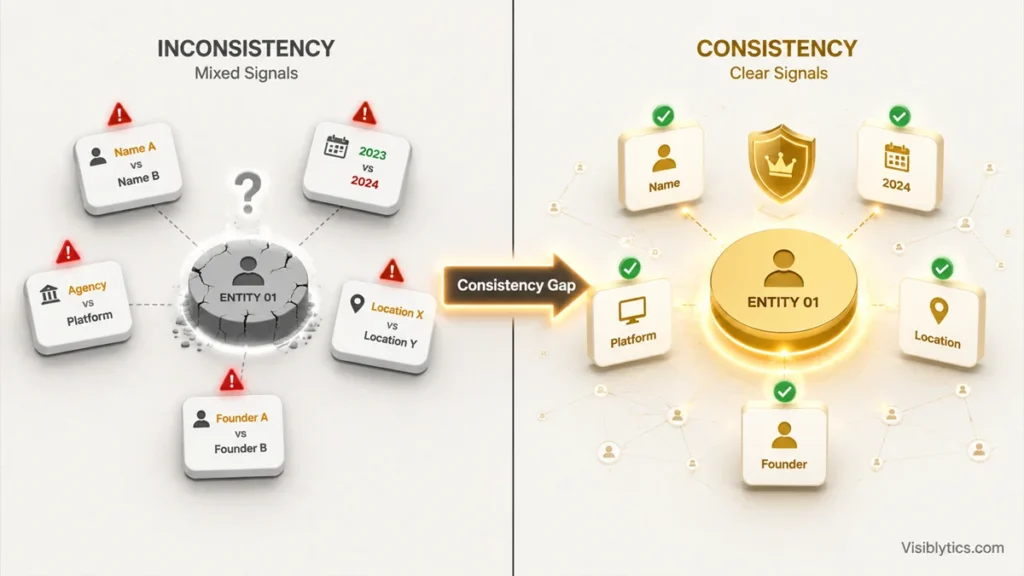
Your company was founded in 2026. Your schema says so. Your entity homepage says so. But a press mention from early in the year says 2023, and an industry directory listing has no date at all. Your LinkedIn profile uses “Visiblytics SEO” while your website uses “Visiblytics.” Your About page calls you an “AI Visibility platform.” Your LinkedIn description says “SEO agency.”
None of these feel like serious problems. They are not. Individually. Together, they produce something that is: an entity that a search engine cannot represent with confidence, a knowledge panel that shows wrong or missing information, and an AI system that skips you entirely when looking for sources to cite on your stated area of expertise.
This is the most common form of entity damage, and it is almost entirely invisible until it accumulates. Entity consistency is the discipline of preventing it, and fixing it once it exists.
What Entity Consistency Actually Is
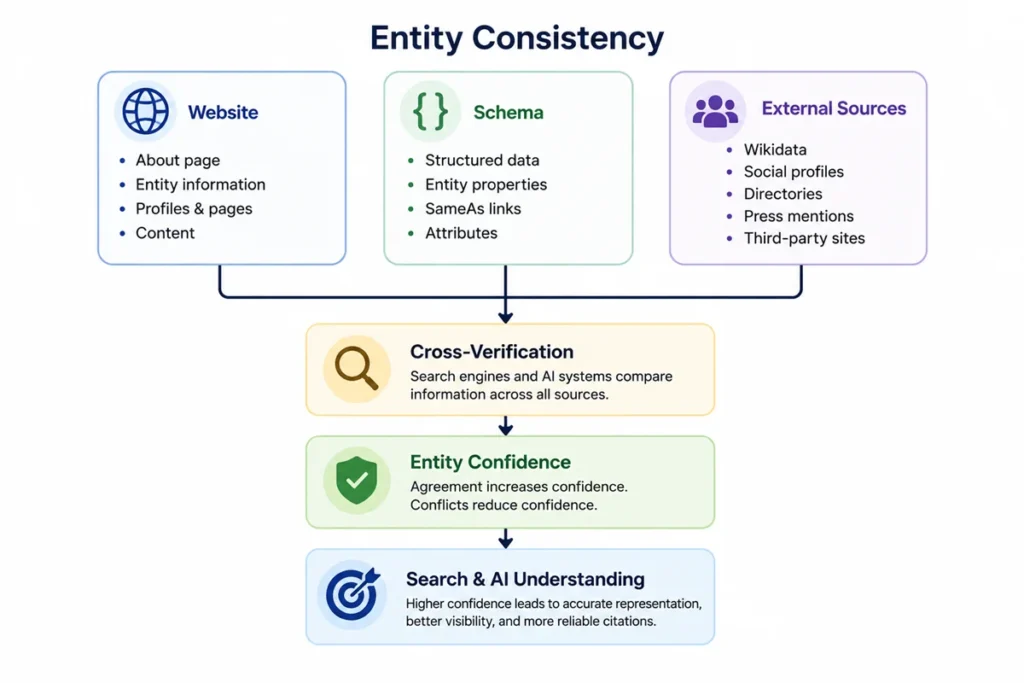
Entity consistency is the degree to which your entity’s core information is identical across every source that references it. It is not the same as accuracy, though accuracy is a prerequisite. An entity can be consistently wrong (every source states the same incorrect founding date) or inconsistently right (the correct information appears on some sources but older, incorrect information persists on others). Both create problems, but inconsistency creates the more complex one because it puts different sources in direct conflict with each other.
Search engines and AI systems build their understanding of your entity by cross-referencing what multiple independent sources say about you. When those sources agree, confidence goes up. When they conflict, even subtly, the system runs a reconciliation process to decide which version is correct. During that process, your entity confidence is lower, your knowledge panel information may be inaccurate, and AI systems may represent you incorrectly or avoid citing you altogether.
Consistency operates at several levels simultaneously:
Name consistency. Your entity name appears identically across your website, your schema markup, your social profiles, your Wikidata entry, your directory listings, and any third-party mentions. “Visiblytics,” “Visiblytics SEO,” and “visiblytics.com” are three different names to a search engine trying to resolve your entity.
Attribute consistency. Your founding date, your location, your category, your description, and your other core attributes are stated the same way across all sources. If your schema says 2026 and a press mention says 2023, that is an attribute conflict requiring reconciliation.
Bio and description consistency. The language used to describe your entity stays aligned across platforms. Different descriptions that use different terminology for the same role or service create topical inconsistency that affects how search engines classify your entity.
Relationship consistency. The connections between your entities are stated consistently on both sides of each relationship. If your organization page names your founder but your founder’s own profiles do not name the organization, the relationship is one-directional and weaker for it.
Visual and brand consistency. Your logo and visual identity match across official profiles. While less directly tied to knowledge graph signals than textual attributes, visual inconsistency contributes to the broader pattern of a poorly maintained entity presence.
How Inconsistency Compounds Over Time
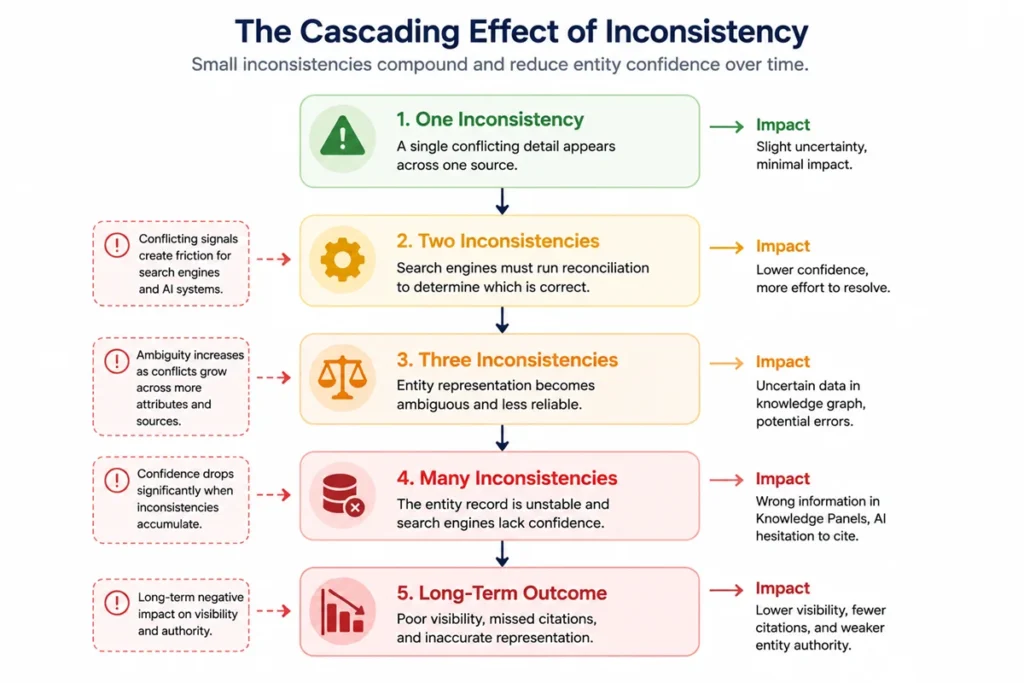
The reason consistency gets underestimated is that the damage it causes is invisible until it accumulates. A single inconsistency, one directory listing with a slightly different company name, rarely produces a noticeable problem on its own. The issue is that inconsistencies do not stay isolated. They interact with each other and compound over time.
Here is how the compounding works. A search engine crawling your entity encounters five sources. Three say your company was founded in 2024. Two say 2023. The system runs reconciliation, picks the majority signal, but stores the entity with lower confidence because the sources are not unanimous. That lower confidence affects how readily the system surfaces your entity for relevant queries. It also means that if a new, high-authority source later states the incorrect date, the system may update toward the wrong answer because the conflict makes both dates plausible.
Now add a second inconsistency. Your company name appears with and without the word “SEO” appended on different platforms. The reconciliation system now has to handle both a date conflict and a name conflict simultaneously. Entity confidence drops further. The pattern looks less like a well-maintained entity and more like two loosely related entities that share some signals.
Add a third: your LinkedIn company description describes you as an “SEO agency” while your website describes you as an “AI Visibility platform.” Now the category classification is ambiguous too.
None of these inconsistencies would be catastrophic alone. Together, they produce an entity that a search engine cannot represent with confidence, a knowledge panel that may show wrong information, and an AI system that may skip you entirely when looking for sources to cite on your area of expertise.
This is the cascading effect of consistency failures. Individually, each inconsistency may appear insignificant. Collectively, they reduce entity confidence, increase reconciliation effort, and make it harder for search engines and AI systems to represent the entity accurately.
NAP Consistency: The Foundation Layer
NAP stands for Name, Address, Phone. It comes from local SEO, where consistent NAP information across directories and listings is essential for how search engines verify and rank local businesses. For entity SEO more broadly, NAP consistency is the minimum viable layer of consistency that every entity needs to have correct before working on anything else.
For a local or location-based entity:
- Name: Exact trading name, identical across every listing. “Visiblytics” not “Visiblytics Ltd” on one platform and “Visiblytics SEO” on another.
- Address: Same format, same abbreviations, same postal code. “Mumbai, India” on one listing and “Mumbai, IN” on another is a minor inconsistency. “Mumbai” versus “Navi Mumbai” is a significant one.
- Phone: Same number, same format. Include or exclude country code consistently.
For non-local entities, NAP in the traditional sense is less relevant, but the principle extends to every equivalent set of core identifiers: the name, the canonical URL, the contact email or primary contact method. These should be identical everywhere they appear.
NAP is the foundation because it is the set of signals most directly used by search engines to verify that two mentions of the same entity name on different platforms are referring to the same real-world entity. When NAP is inconsistent, the verification process fails at the most basic level.
Bio and Description Consistency
Bio consistency is where I see the most practical damage for individual professionals and founder-led businesses, because bios tend to evolve over time and rarely get updated everywhere simultaneously.
A typical inconsistency pattern: a founder writes a bio for their website that reflects their current role and focus. They have an older bio on LinkedIn that reflects where they were two years ago. Their guest article author bio from eighteen months ago describes a role they no longer hold. Their Wikidata entry, if they have one, was set up by someone else and has never been updated.
Now a search engine is trying to build a person entity for this founder. It has four different descriptions of who they are and what they do. The system has to decide which version is the current, authoritative one. If the website bio is the most recent and best-structured source, the system will likely weight it most heavily, but the conflicting signals from the other sources reduce its confidence in that weighting.
The standard for bio consistency is not that every bio is identical word for word. It is that every bio uses the same core claims: the same name, the same current title, the same organizational affiliation, the same primary area of expertise. The wording can vary. The facts cannot.
What bio consistency looks like in practice:
Every bio, across every platform, should agree on:
- Full name in the exact professional form used everywhere
- Current job title or role description
- Current organizational affiliation
- Primary area of professional expertise
- Any credentials that are claimed, using the same credential names
What can vary between bios:
- Length and level of detail
- Tone (formal for directories, conversational for a podcast guest bio)
- Which secondary details are included
Schema Consistency: The Machine-Readable Layer
Schema markup is your entity’s machine-readable source of record. Every attribute you state in schema should match exactly what you state in prose on the same page and on every external source that references the same attribute.
The most common schema consistency failures I encounter:
Schema that contradicts the page it is on. Your About page says you founded the company in 2026. Your Organization schema on the same page says 2023. The system encounters contradictory signals from the same source, which is a stronger conflict than two separate external sources disagreeing.
sameAs links pointing to outdated or inconsistent profiles. Your sameAs references are supposed to confirm that the entity on your site and the entity on each linked platform are the same thing. If the LinkedIn profile in your sameAs uses a different company name than your schema, the sameAs link is introducing a conflict rather than corroborating your entity.
Person schema that contradicts Organization schema. Your Organization schema lists a founder. Your Person schema for that founder uses a different spelling of their name or links to a different organization URL. Two schema blocks on the same site should tell a consistent story about the same entity network.
Schema that is never updated after changes. A job title changed, a company pivoted, a URL moved. The website content got updated. The schema did not. The result is a machine-readable entity record that contradicts the human-readable content on the same page.
The Schema Markup Generator handles building schema correctly, and the Structured Data Testing Tool validates it before publishing. Neither tool can catch the consistency failure of schema that is technically valid but factually inconsistent with the rest of your entity’s presence. That check has to be done manually.
Cross-Platform Consistency
Cross-platform consistency is the external layer: making sure every platform where your entity has a presence reflects the same core information.
Not every platform contributes equally to entity consistency. While search engines do not publish an official weighting of sources, some platforms generally provide stronger corroborative signals because they are authoritative, independently maintained, and widely referenced. The following sources are listed in a practical order of priority for consistency audits rather than as an official ranking.
Your entity homepage. This is the anchor. Everything else should match it. If you change something here, it is the signal that all other sources need to be updated to reflect. The full guide to building and maintaining your entity homepage is at What Is an Entity Homepage?.
Wikidata. Wikidata feeds directly into multiple knowledge graph systems and carries high authority as an independent, structured source. If your Wikidata entry contradicts your entity homepage, you have a high-authority conflict that is harder to resolve than a low-authority directory discrepancy.
Wikipedia. Where a Wikipedia article exists for your entity, it carries significant weight. Incorrect or outdated information in a Wikipedia article is a high-priority consistency fix, but one that requires following Wikipedia’s editorial process rather than direct editing.
LinkedIn. For both organizational entities and person entities, LinkedIn is one of the most-crawled, most-trusted professional platforms. Company names, founding dates, employee counts, and individual job titles on LinkedIn feed into entity signals.
Social profiles. Twitter/X, Facebook, YouTube, and other active social profiles contribute corroboration signals. Their consistency value comes primarily from matching your entity homepage: same name, same description, same category.
Industry directories and structured listings. Crunchbase, Google Business Profile, industry-specific directories. These carry moderate authority individually but contribute meaningfully through volume and consistency.
Third-party mentions and press. These are the hardest to control because they are produced by external parties. Where incorrect information appears in a press piece or external profile, the practical options are limited: request a correction if the outlet is responsive, or ensure that your higher-authority sources are so consistently correct that they outweigh the conflicting signal.
The Consistency Audit Process
Before you can fix consistency problems, you need to find them systematically. Here is the audit process I use.
Step 1: Define your authoritative entity record. Before auditing anything external, decide what the correct version of every core attribute is. Your exact entity name. Your exact founding date. Your exact description. Your exact professional title. Your exact category. Write these down. This is the standard everything else will be checked against.
Step 2: Audit your own site first. Check your entity homepage content against your schema. Check your author page content against your Person schema. Check every bio that appears on your site. Every attribute should match the authoritative record exactly.
Step 3: Audit Wikidata. Search for your entity on Wikidata. If an entry exists, check every attribute against your authoritative record. If it does not exist, note this as a gap.
Step 4: Audit social profiles. Check LinkedIn, Twitter/X, and any other active profiles. Name, description, category, website URL. Note every discrepancy.
Step 5: Search for third-party mentions. Search your entity name in Google. Review the top 30 results. Note every version of your name, description, or attributes that differs from your authoritative record.
Step 6: Check directories. Search for your business in Google Business Profile, Crunchbase, and any industry-specific directories you know you are listed in. Note every inconsistency.
Step 7: Document all conflicts by source authority. List every inconsistency found, note the source it appears on, and rank them by the authority of that source. Fix high-authority conflicts first.
How to Fix Consistency Problems
Fix in order of source authority, starting with your own site and working outward.
Fix your entity homepage and schema first. Your entity homepage is the anchor that everything else is checked against. If it is wrong, fixing external sources to match it makes the problem worse. Get your own house in order before touching anything external.
Update Wikidata where appropriate. If your Wikidata entry contains incorrect information, update it using reliable references wherever possible. Because Wikidata is community-maintained, unsupported edits may be reverted. If no entry exists, only consider creating one if the entity meets Wikidata’s notability requirements and can be supported with independent sources.
Update social profiles. LinkedIn, Twitter/X, and similar profiles are directly within your control. Match them to your entity homepage exactly.
Contact directories for corrections. Many directories have an update or claim process. Work through the highest-authority ones first.
For uncontrollable external mentions. Where a press piece or external article contains incorrect information and the outlet is unresponsive, focus on ensuring that your higher-authority sources are definitively correct. A single incorrect press mention outweighed by five consistent high-authority sources is a manageable conflict. The same incorrect information appearing across many sources requires more aggressive outreach.
Update schema immediately after any entity change. Any time something about your entity changes, update your schema on the same day. Schema is the machine-readable source of record. Letting it fall out of sync with your current entity reality is the most preventable consistency failure available.
Consistency as an Ongoing Practice
Entity consistency is not a one-time audit. It is an ongoing discipline. Every time your entity changes, every name update, every role change, every pivot, every new product launch, you are creating a new consistency maintenance task.
The practical approach is to build a consistency update into your process for any entity change. When the change happens, update in this order:
- Entity homepage content
- Schema markup
- Wikidata
- Social profiles
- Directory listings (as time allows)
This order ensures that the highest-authority sources reflect the new information first, which is what matters most for how search engines and AI systems process the change.
A quarterly consistency check is also worth building into your routine, even when no significant changes have happened. External sources drift: bios get edited by third parties, directory listings get auto-populated with old data, Wikipedia articles get updated with information from other sources. A periodic check catches the drift before it accumulates into a significant conflict.
The connection between consistency failures and the reconciliation process that resolves them is covered in detail in the Entity Reconciliation guide.
Consistency and AI Visibility
AI systems are particularly sensitive to entity consistency because they draw from multiple sources when constructing answers. A retrieval-based AI system like Perplexity or Google AI Overviews that encounters conflicting entity signals across the sources it retrieves has to make a judgment call about which version is correct. It may pick the right one, or it may not. It may hedge by describing your entity in vague terms that avoid committing to either conflicting version. It may skip citing you altogether in favor of a more clearly-defined source.
A highly consistent entity removes this judgment call. When every source agrees, the AI system can represent your entity with confidence. That confidence is what produces accurate citations, accurate descriptions, and reliable inclusion in AI-generated answers about your area of expertise.
This is why entity consistency is the prerequisite layer noted in the Digital Authority guide: before recognition, before authority-building, before any of the higher-order signals matter, the foundational information about your entity has to be consistent enough for a search engine or AI system to trust it.
The full framework for how entity consistency feeds into AI Visibility is covered in the AI Visibility guide.
Entity Consistency Checklist
Authoritative record:
- Exact entity name documented and confirmed as the standard for all sources
- Exact founding date confirmed
- Exact current description written in factual, neutral language
- Exact current professional title and organizational affiliation confirmed (for person entities)
Own site:
- Entity homepage content matches authoritative record exactly
- Schema markup matches entity homepage content exactly
- All author bios use same name, title, affiliation, and expertise claims
- sameAs links point to active, consistently-named external profiles
External sources:
- Wikidata entry exists, is accurate, and matches authoritative record
- LinkedIn company page and/or personal profile matches authoritative record
- Twitter/X and other active social profiles match authoritative record
- Google Business Profile accurate (if applicable)
- Key industry directories checked and consistent
Ongoing:
- Schema updated on the same day as any entity change
- Quarterly consistency check scheduled
- Process in place for updating external sources after any entity change
❓ Frequently Asked Questions
What is entity consistency in SEO?
Entity consistency is the practice of ensuring that every piece of core information about your entity, your name, description, founding date, professional role, and category, appears the same way across every source that references it. It matters because search engines and AI systems build entity confidence by cross-referencing multiple sources. When sources conflict, confidence drops and the entity is harder to represent accurately in search results and AI-generated answers.
How is entity consistency different from entity accuracy?
Accuracy means the information is correct. Consistency means it is the same across all sources. An entity can be consistently wrong (all sources state the same incorrect founding date) or inconsistently right (the correct information appears on some platforms but not others). Both create problems. Inconsistency is the more complex problem because it puts sources in direct conflict with each other, which triggers the reconciliation process.
What is NAP consistency and does it matter for non-local businesses?
NAP stands for Name, Address, Phone, the core identifying information for local businesses. NAP consistency is the practice of keeping these identical across all listings. For non-local entities, the same principle applies to equivalent identifiers: the entity name, the canonical URL, and the primary contact information. Any core identifier that appears differently across sources creates a potential disambiguation or reconciliation problem.
How do I find entity consistency problems?
Start by defining your authoritative record: the exact correct version of every core attribute. Then audit in order: your own entity homepage and schema first, then Wikidata, then social profiles, then a Google search for your entity name to surface third-party mentions. Note every discrepancy against your authoritative record and rank them by the authority of the source they appear on.
How quickly do search engines respond to consistency fixes?
There is no verified universal timeline. Fixes to your own schema and entity homepage are processed when search engines next crawl your site. Changes to Wikidata are typically processed relatively quickly. Changes to social profiles and directories depend on how frequently those platforms are crawled. External press mentions that contain incorrect information are outside your control and may persist indefinitely. Focusing on high-authority sources first produces the most meaningful improvement in entity confidence over time.
Does entity consistency affect AI citations?
Yes directly. AI retrieval systems draw from multiple sources when constructing answers. Conflicting entity signals across those sources force the AI to make a judgment call about which version is correct, which can produce inaccurate representations or cause the system to avoid citing your entity altogether. A consistently represented entity removes that ambiguity and produces more reliable, more accurate AI citations.
How often should I audit entity consistency?
A thorough audit whenever a significant entity change occurs (rebrand, role change, new focus area, URL change) and a lighter quarterly check to catch drift in external sources. Schema should be updated on the same day as any entity change. External sources should be updated as a priority in the days following any change, starting with Wikidata and social profiles.
Consistency Is the Layer Everything Else Depends On
Every other entity SEO discipline, building attributes, mapping relationships, earning authority, developing digital authority, depends on a consistent entity foundation to work correctly. Attributes that are stated inconsistently across sources produce attribute conflicts. Relationships that are corroborated on one side but contradicted on another produce weaker relationship signals. Authority built from mentions of an inconsistently-named entity produces split signals rather than cumulative confidence.
Consistency is not glamorous work. It does not produce visible results the way a knowledge panel appearance does. But it is the layer that makes every other piece of entity work more effective, and the layer that, when neglected, quietly undermines everything built on top of it.
The Entity SEO guide covers the complete five-component entity framework. The Entity Reconciliation guide covers what happens when consistency problems go unresolved long enough for search engines to have to reconcile the conflicts themselves.