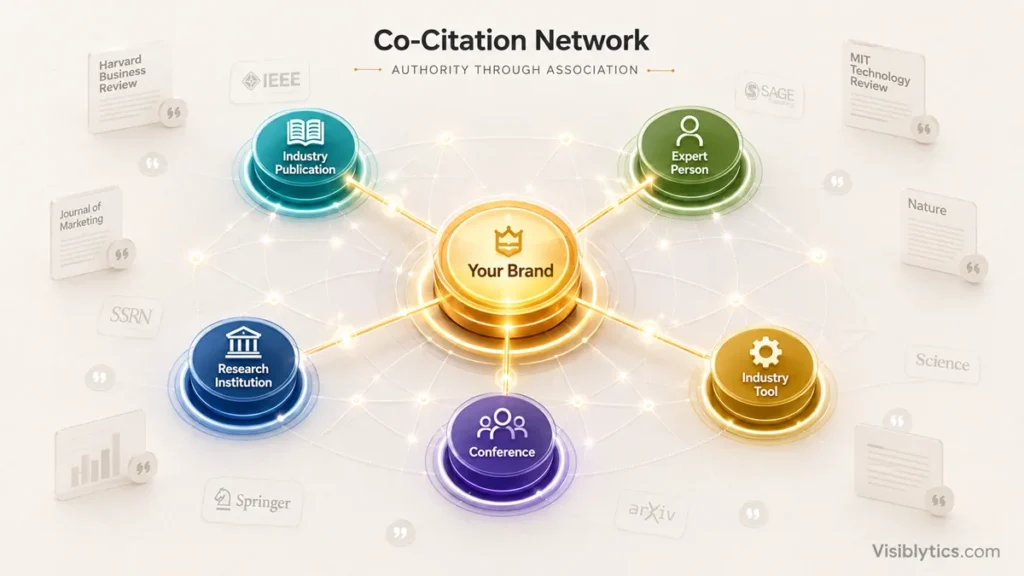
A co-citation occurs when two entities are mentioned together in the same piece of content without necessarily being linked to each other. When a publication writes about Entity SEO and mentions both Visiblytics and Google in the same article, that is a co-citation between those two entities. Neither needs to link to the other. The mere fact of appearing in the same content, in the same topical context, creates an associative signal that search engines and AI systems use to understand the relationship between entities and the topical network they operate within.
Co-citations matter for digital authority because they are one of the mechanisms through which topical entity associations are built outside your own domain. You control what your own pages say about you. You cannot fully control which entities appear alongside yours in third-party content. When credible publications consistently place your entity in the same context as recognized authorities in your field, that pattern of association becomes a trust signal that neither links nor mentions alone can fully replicate.
What Is a Co-Citation?
A co-citation is a relationship signal created when two or more entities are referenced in the same piece of content, regardless of whether those entities link to each other. The term comes from academic citation analysis, where researchers who are cited together in the same papers develop an associative relationship in bibliographic databases: the co-citation implies that both researchers are relevant to the same body of knowledge.
In search and AI contexts, co-citation works at the entity level rather than the page level. When content about AI Visibility consistently mentions Visiblytics alongside other recognized players in that space, the co-citation pattern creates an entity-level association: Visiblytics is topically associated with AI Visibility in the same way that the co-cited entities are. That association feeds into how knowledge graphs represent entity networks and how AI systems construct the topical landscape when answering questions about a subject.
Co-citation is distinct from two related concepts that are worth separating clearly:
Co-citation vs co-occurrence. Co-occurrence is the broader term for any two things appearing together in content. Co-citation is a specific type of co-occurrence where both items are being referenced as entities in their own right, not just as terms. A sentence that uses the words “Google” and “Visiblytics” in passing is co-occurrence. A sentence that discusses both Google and Visiblytics as distinct entities with specific roles in AI Visibility is co-citation. As covered in the Entity Salience guide, co-occurring entities shape the topical context in which a primary entity is understood. Co-citation is the form of co-occurrence that produces the strongest topical association signals.
Co-citation vs backlinks. A backlink creates a direct hyperlink relationship between two pages. A co-citation creates an associative entity relationship through shared context. Both matter, but they feed different systems. Backlinks feed traditional link authority signals. Co-citations feed entity relationship signals and topical authority signals. A co-citation without a link still produces entity association value. A backlink without meaningful topical co-citation context (a link in an unrelated page, a link from a site with no topical relevance) produces less entity association value than a co-citation in topically relevant content.
How Search Engines and AI Systems Use Co-Citations
Search engines have been studying co-citation patterns since at least the early 2010s, when Google’s Penguin updates began deprioritizing links that lacked editorial context. The interest in co-citation comes from its ability to reveal entity relationships that are not captured by links alone.
Topical entity association. When an entity is consistently co-cited with recognized authorities on a specific topic, that pattern tells the search engine: this entity belongs in this topical network. The more consistent the pattern and the more authoritative the co-citing sources, the stronger the association. This is one of the mechanisms through which topical authority is built.
Entity relationship mapping. Co-citation helps knowledge graphs identify implicit relationships between entities. If a large number of authoritative sources discuss Visiblytics and Entity SEO together, the knowledge graph has evidence for a “specializes in” or “publishes about” relationship between the two entities, even if that relationship has never been explicitly stated in structured data.
Trust by association. Appearing alongside highly trusted entities in relevant content is an implicit trust signal. If the most credible publications in a field consistently include your entity in the same context as the recognized leaders in that field, the associative signal reinforces your entity’s credibility in that domain.
For AI systems specifically, co-citation patterns influence how AI systems construct the landscape of a topic when building a response. When an AI system is asked about the leading resources on Entity SEO, it draws on patterns of which entities are associated with that topic in its training data and live retrieval. An entity that is consistently co-cited with authoritative sources on Entity SEO has a stronger topical association signal than one that is only self-associated with the topic through its own content.
As covered in the Entity Disambiguation guide, co-citation context is one of the signals disambiguation systems use to resolve ambiguous entity names. An entity that is consistently co-cited with a coherent set of topically related entities is easier to disambiguate than one whose co-citation profile is scattered across unrelated contexts.
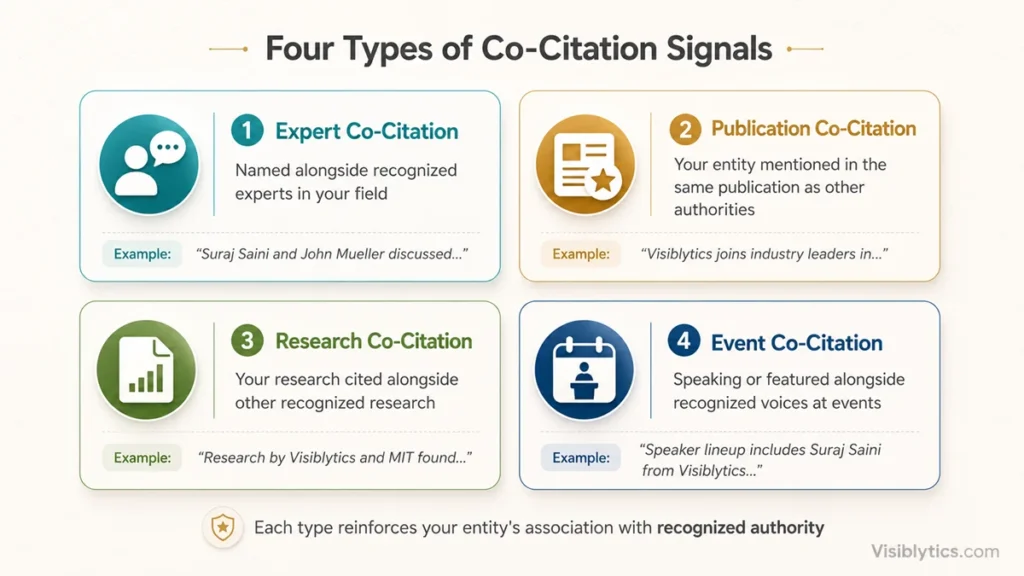
Types of Co-Citation That Build Entity Authority
Co-citations are not all equal. The type of content in which two entities are co-cited, and the nature of the co-citation relationship, affect how much topical authority signal is produced.
Editorial Co-Citations
Editorial co-citations occur when a journalist, editor, or recognized writer independently chooses to mention two entities in the same piece of content because both are genuinely relevant to the topic being covered. These are the highest-authority co-citation type because they reflect an independent editorial judgment, not a commercial relationship or a link exchange.
An article in a credible SEO publication that discusses the key players in AI Visibility and includes both Visiblytics and Google is an editorial co-citation. The writer has made an independent judgment that both entities are relevant to the same conversation. That judgment is a quality signal that search engines and AI systems treat as meaningful.
Research and Academic Co-Citations
When original research cites multiple entities in the same methodological or comparative context, the co-citation is particularly strong. A benchmark study that compares how ChatGPT, Gemini, Claude, and Perplexity handle Entity SEO queries produces co-citations among those entities in a structured, authoritative format. If that research is then cited by other publications, the co-citation pattern propagates across multiple sources.
Research co-citations have strong compounding properties: when a frequently-cited research paper mentions two entities together, every subsequent citation of that paper is effectively also a co-citation of those entities. This is one of the reasons why original research is particularly effective for building entity associations that compound over time.
Comparative and Alternative Co-Citations
When publications write “X vs Y” comparisons, “alternatives to X” lists, or “top tools for Y” roundups, they produce co-citations in a comparative context. Being included in a well-researched “top Entity SEO resources” list alongside recognized tools and practitioners is a co-citation that places your entity in a specific competitive and topical context.
The authority of the co-citation depends on the publication and the methodology. An editorially produced comparison from a credible publication is a strong signal. A low-quality “top 50 SEO tools” list from an SEO-optimized directory is a weak one.
Directory and Categorical Co-Citations
Being listed in credible industry directories alongside other recognized entities in the same category is a form of co-citation. Wikidata’s category system explicitly groups entities that operate in the same domain. Industry association member lists, conference speaker lineups, and professional directory categories all produce categorical co-citations that contribute to entity network positioning.
These are weaker individually than editorial co-citations but contribute to cumulative association signals, particularly when multiple credible directories consistently place your entity in the same categorical context.
How Co-Citations Feed Into Knowledge Graph Position
The practical importance of co-citation for knowledge graph position is that it helps establish where your entity sits in the entity network, not just that it exists.
A knowledge graph is a network of entities connected through relationships. Co-citation patterns provide implicit evidence for relationships that may not be explicitly stated anywhere. When authoritative sources consistently co-cite your entity with the recognized entities in a specific domain, the knowledge graph has evidence that your entity is part of that domain’s network, even without a formally declared relationship in structured data.
This matters because knowledge graph position affects more than just branded search results. It affects:
Query association. An entity well-positioned in a topical knowledge graph network is more likely to appear in search results for queries in that topic area, not just for branded searches.
Knowledge panel content. The related entities that appear in a knowledge panel are partly determined by co-citation patterns. An entity consistently co-cited with recognized players in a field may have those entities appear as related in its knowledge panel.
AI topic maps. When an AI system constructs its understanding of a topic area to answer a question, it draws on the entity network associated with that topic. An entity well-positioned in that network through co-citation is more likely to appear in the AI’s constructed topic map.
Entity trust by network proximity. Entities that are close to recognized, trusted entities in the knowledge graph benefit from a form of trust by network proximity. Co-citation with authoritative entities builds that proximity.
The connection between entity relationships and knowledge graph position is covered in depth in the Entity Relationships guide and the Knowledge Graph guide.
How to Build Co-Citation Signals Deliberately
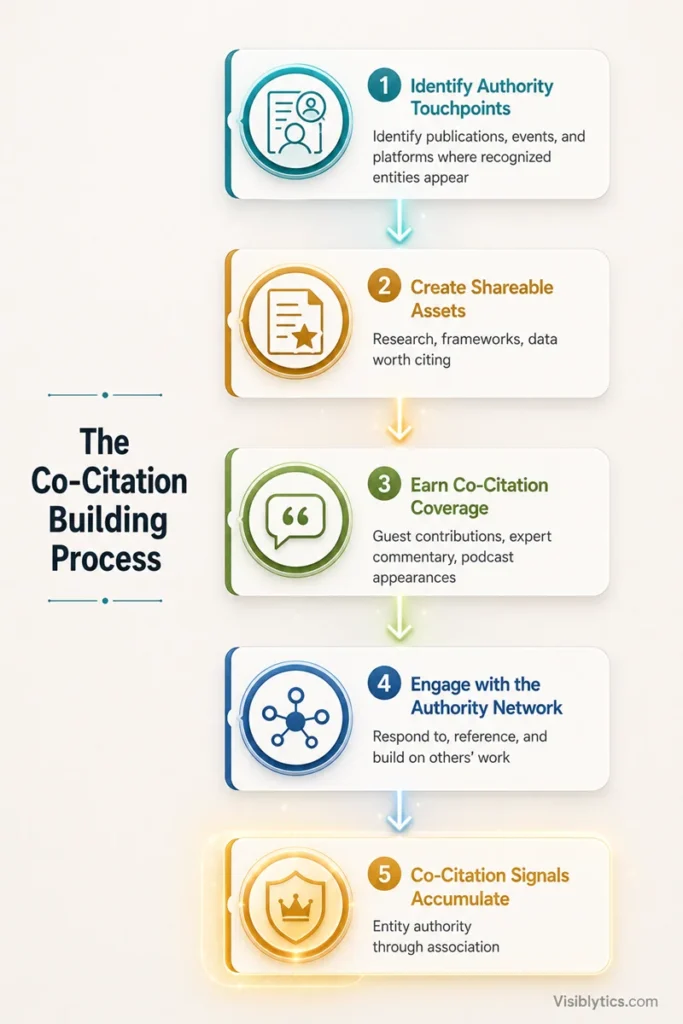
Co-citations are partly earned organically (other sources choose to mention your entity alongside others without prompting) and partly influenced deliberately. Here is how to influence the pattern.
Publish content that references recognized entities in your field. When you publish content that analyzes, compares, or engages with the work of recognized entities in your topic area, you create co-citation signals from your own content while establishing topical association. More importantly, you create the kind of engaged, substantive content that other credible sources are more likely to cite, which produces co-citations from those external sources.
Contribute to roundups and multi-source features. Publications that produce roundup features, expert panels, and multi-contributor pieces naturally generate co-citations between all the contributors. Being included in a “10 experts on Entity SEO” feature co-cites your entity with the other nine experts. Actively pursuing inclusion in well-researched, editorially rigorous multi-source features is an efficient way to build co-citation signals with recognized peers.
Position your original research in comparison to existing benchmarks. When your research explicitly compares its findings to existing benchmarks or references existing studies, the research document co-cites your entity with the existing authority sources. That co-citation propagates to every publication that subsequently cites your research.
Pursue speaking appearances and conference features alongside recognized peers. Conference programs, panel lineups, and event speaker pages are categorical co-citation documents. A conference speaker page that lists your name alongside recognized authorities in your field is a co-citation signal from the organizing body, which itself carries institutional credibility.
Engage visibly with the conversation in your field. Publicly engaging with the ideas of recognized entities in your field, responding to their arguments in your own published content, and contributing substantively to ongoing conversations creates the conditions under which those entities and publications may co-cite you in return. Co-citation patterns are partly shaped by who is visibly participating in the same conversation.
Target the publications that already co-cite your peers. Identify which publications regularly cover your topic area and co-cite the recognized entities you want to be associated with. Those publications are already predisposed to create co-citations in your topic area. Earning coverage from them produces co-citations in the same context where your peers are already being co-cited.
Auditing Your Co-Citation Profile
Understanding your current co-citation profile tells you which topical associations have already formed around your entity and which gaps exist.
Step 1: Search your entity name in Google. Review the top 30 to 50 results. For each result that mentions your entity, note what other entities appear in the same content. Are they in your topic area? Are they recognized authorities? Are they competitors or complementary entities? This gives you a basic picture of your current co-citation context.
Step 2: Check which entities you are co-cited with most frequently. If you appear consistently alongside a specific set of entities, that pattern is building a topical association with that cluster. If you appear in scattered, unrelated contexts, your co-citation profile lacks topical coherence.
Step 3: Identify which entities you want to be co-cited with. These are the recognized authorities in your specific topic area: the brands, researchers, tools, and practitioners whose proximity in the knowledge graph would strengthen your entity’s topical positioning.
Step 4: Identify the publications that co-cite those entities. Search those target entities and note which publications regularly feature them in relevant topical content. These are your target publications for co-citation building.
Step 5: Assess the quality of your existing co-citations. Not all co-citations are equal. A co-citation in a credible editorial publication carries more weight than one in a low-quality directory. Review whether your existing co-citation profile is dominated by strong editorial signals or by weak directory and low-authority content signals.
Co-Citation Mistakes That Weaken Topical Association
Appearing in low-quality directories alongside unrelated entities. Being listed in generic, low-quality directories that group unrelated entities together produces co-citations that signal no specific topical association. A directory that lists plumbers, SEO agencies, and pet shops in the same category is not building a meaningful topical co-citation signal.
Pursuing coverage in publications unrelated to your topic area. A mention in a high-DA publication that has no topical relevance to your field produces a co-citation with unrelated entities. The authority of the publication matters less than the topical relevance of the context in which you are co-cited.
Ignoring the entity context of mentions. When pursuing press coverage or expert commentary placements, evaluate not just the publication’s authority but which other entities are regularly featured in the same topical context. A publication that consistently co-cites your target peers is more valuable for co-citation building than one that covers your topic area only occasionally.
Allowing co-citation profile to scatter across unrelated topics. If your entity is co-cited with entities in Entity SEO, cooking, finance, and travel because your content covers all of those areas, your co-citation profile has no topical coherence. Search engines and AI systems use co-citation patterns to build entity network position. A scattered profile builds no clear position anywhere.
❓ Frequently Asked Questions
What is a co-citation in SEO?
A co-citation occurs when two entities are mentioned together in the same piece of content, regardless of whether they link to each other. The co-citation creates an associative signal between the two entities that search engines and AI systems use to understand entity relationships and topical networks. In SEO, co-citation matters because it contributes to topical authority signals and knowledge graph entity positioning.
How is co-citation different from a backlink?
A backlink is a direct hyperlink from one page to another. A co-citation is a mention of two entities in the same content without a required link between them. Backlinks feed traditional link authority signals. Co-citations feed entity association and topical authority signals. A co-citation from topically relevant, credible content can be more valuable for entity authority than a backlink from a topically unrelated page.
Do unlinked co-citations count?
Yes. Co-citations do not require links to produce entity association signals. Search engines identify entity mentions through Named Entity Recognition, and AI systems process the topical context of content independently of its link structure. A mention of two entities in the same topically relevant, credible content produces a co-citation signal regardless of whether either entity is hyperlinked.
How is co-citation different from co-occurrence?
Co-occurrence is the broader term for any two things appearing in the same content. Co-citation is a specific type of co-occurrence where both items are referenced as distinct entities in their own right rather than just as terms in passing. Co-citation in the context of topically relevant, authoritative content produces a stronger entity association signal than general co-occurrence.
Can I control which entities I am co-cited with?
Partially. You can influence your co-citation profile by: publishing content that engages with recognized entities in your field, pursuing coverage in publications that already co-cite your target peers, contributing to multi-source features and expert roundups, and positioning your research in comparison to existing work by recognized entities. You cannot control what every third-party publication chooses to write, but deliberate positioning in the right publication contexts shapes the co-citation pattern over time.
How do co-citations help with AI visibility?
AI systems use co-citation patterns to construct topical entity networks when building responses to questions about a subject area. An entity that is consistently co-cited with recognized authorities in a topic area has stronger topical association signals in the AI’s understanding of that domain, making it more likely to appear in AI-generated answers about that topic. Co-citations contribute to the entity recognition layer that AI systems draw on when deciding which sources to cite.
Association Is Built by Proximity, Not Just by Links
The traditional SEO mental model prioritizes links as the primary signal of entity relationships and authority. Links matter and will continue to matter. But the knowledge graph systems and AI retrieval systems that increasingly determine search and citation outcomes operate on a richer signal set that includes co-citation patterns as a meaningful input.
An entity that appears consistently alongside recognized authorities in its field, in credible editorial content, on relevant topical subjects, is building a form of authority through association that compounds over time. Each co-citation adds to the pattern. The pattern builds topical network position. The position influences how search engines and AI systems represent your entity when someone asks a question in your domain.
For the broader framework of how co-citations connect to digital authority, the Digital Authority guide covers the full picture. For how co-citation patterns relate to entity relationships in knowledge graphs specifically, the Entity Relationships guide and the Knowledge Graph guide cover the structural mechanics.