Two articles on the same topic. Same depth. Same research. Same quality.
One is published under a named author: a complete author page, Person schema, a Wikidata entry, consistent credentials across platforms, and a track record of cited work in this topic area. The other is published under “Admin,” with no author page, no schema, no external profile, no way for a search engine or AI system to verify who wrote it or whether they know anything about the subject.
When an AI system like ChatGPT or Gemini is constructing an answer and retrieving sources, it evaluates content at the author level. The first article is a citable source from a verified expert entity. The second is content from an unknown. Same words. Completely different citation likelihood.
Author authority is the work of being the first article, not the second. It is the accumulated credibility of a person entity as a recognized, verifiable expert source in a specific topic area. It is built at the person level, not the website level, and it compounds across every platform, publication, and professional context where that person appears.
What Author Authority Is
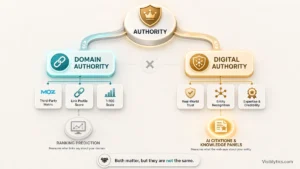
Author authority is the accumulated credibility of a person entity as a recognized source in a specific topic area. It is distinct from organizational authority (how well a brand is recognized) and from Domain Authority (how strong a website’s link profile is). A person can have strong author authority on a topic and work for an organization with modest brand recognition. A brand can have strong organizational authority in a market while its individual authors have weak person entity profiles.
Author authority is built from three layers working together:
Verifiability. Can a search engine or AI system confirm that this person is who they claim to be? This layer is built through consistent entity signals: a complete Person schema on their author page, a Wikidata entry, consistent professional profiles across platforms, and named credentials that can be independently verified.
Expertise. Does this person have a demonstrated track record of knowledge in their stated area? This layer is built through content production: a consistent body of work on a specific topic, original research or analysis, and the kind of depth that distinguishes genuine expertise from surface familiarity.
Recognition. Have independent, credible sources acknowledged this person as an authority in their field? This layer is built through external mentions: attributed quotes in publications, citations of their work, invitations to speak or contribute, and the pattern of other recognized sources referencing them in professional context.
All three layers are necessary. Verifiability without expertise produces a machine-readable nobody. Expertise without verifiability produces an anonymous expert that AI systems cannot attribute. Recognition without verifiability produces brand awareness without entity corroboration. The combination of all three is what produces an author that search engines confidently attribute content to and AI systems confidently cite.
The Author Authority Stack
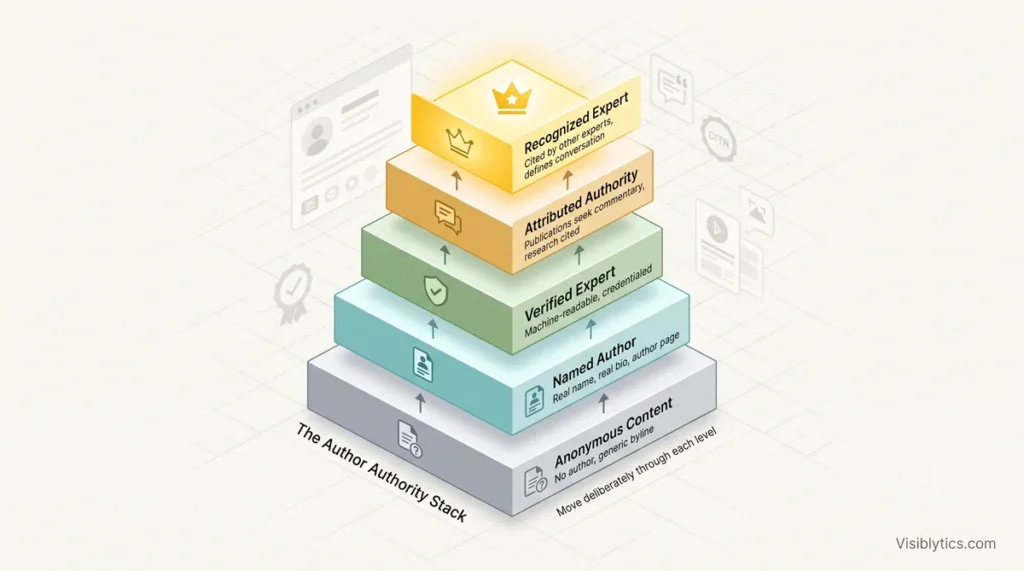
I find it useful to think of author authority as a stack, where each level depends on the one below it and where most authors stall at a specific level rather than progressing through all of them.
Level 5: Recognized Expert
    ↑ Cited by other experts, invited to define the conversation
Level 4: Attributed Authority
    ↑ Publications seek you out for commentary, research is cited
Level 3: Verified Expert
    ↑ Machine-readable, credentialed, consistently represented
Level 2: Named Author
    ↑ Real name, real bio, real author page, linked to content
Level 1: Anonymous Content
    ↓ No author, generic byline, no entity signals
Most brand content sits at Level 1 or Level 2. The content exists but is either anonymous or has a name attached with no entity foundation beneath it. AI systems treat Level 1 and 2 content as low-confidence sources because they cannot verify the author’s identity or expertise.
Levels 3, 4, and 5 are where author authority produces meaningful outcomes for search visibility, AI citations, and professional recognition. Moving from Level 2 to Level 3 is primarily technical work: entity pages, schema, credentials, consistent external profiles. Moving from Level 3 to Level 4 and 5 is primarily recognition work: external mentions, attributed quotes, published research, community standing.
The goal of this guide is to help you move through this stack deliberately rather than waiting for recognition to accumulate organically.
Building the Author Page
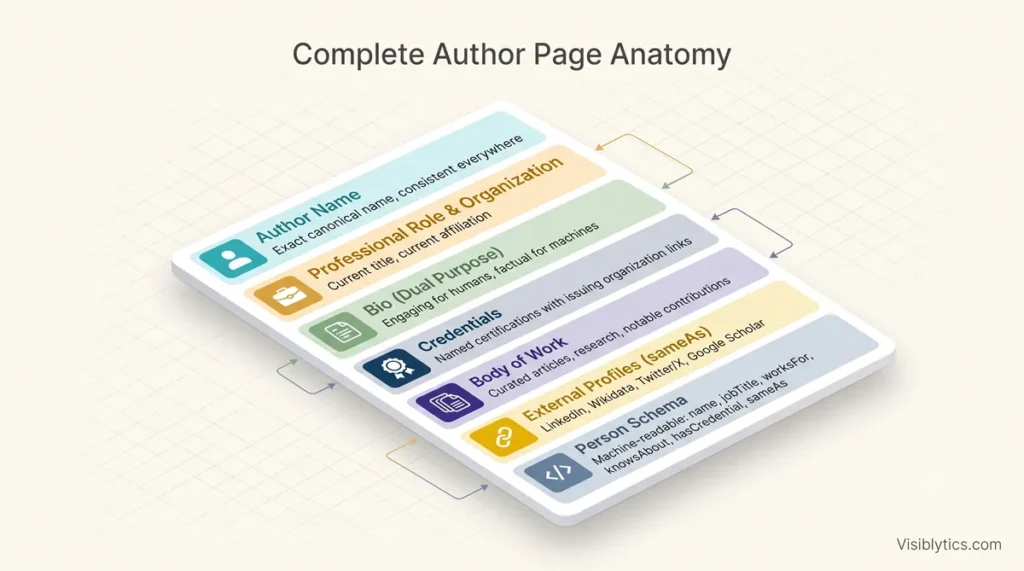
The author page is the foundation of author authority. It is the person entity homepage, the single page that functions as the machine-readable source of record for everything a search engine or AI system needs to know about this author.
What a strong author page contains is covered in part in the Personal vs Brand Entities guide and the Entity Homepage guide. This section focuses specifically on what an author page needs to do for author authority rather than entity clarity in general.
The name, stated exactly. Not a nickname, not a first name only, not a variation. The exact name that appears in every byline, every external profile, and every professional mention. If your bylines say “Suraj Saini” then your author page, your LinkedIn, your Twitter/X, and your Wikidata entry all say “Suraj Saini.” No variations.
The professional role and organizational affiliation, current. Your current title and current organization. Updated the moment either changes. A stale title on an author page is an entity inconsistency that creates a conflict with external sources that reference your current role. The specific schema properties for this are covered in the Entity Attributes guide.
A bio written for entity recognition, not just audience engagement. Most author bios are written to engage human readers: they are warm, sometimes witty, and designed to create connection. An author page bio should do that and serve a second purpose: it should state, in clear factual language, what this person’s area of expertise is, what their credentials are, and what their organizational affiliation is. The factual layer needs to be there even if the tone is conversational.
A complete credential listing. Every relevant certification, qualification, or formal recognition. Named credentials linked to the issuing organization where possible. “Google Analytics Certified” linked to the Google certification program is stronger than “certified in analytics” with no specifics.
A body of work section. A curated list of notable articles, research, or contributions this author has produced. This creates topical salience: a reader (and a crawler) can see at a glance that this person writes consistently about Entity SEO and AI Visibility rather than randomly across unrelated topics.
Verified external profile links. LinkedIn, Twitter/X, Wikidata, Google Scholar where applicable, and any other professional platforms where this author has a maintained presence. These are the sameAs references that tell search engines: the Suraj Saini on this page and the Suraj Saini on LinkedIn are the same entity.
Person schema covering all of the above. The schema is what makes the above machine-readable without requiring inference. The Entity Attributes guide covers the specific properties: name, jobTitle, worksFor, knowsAbout, hasCredential, sameAs.
The Byline-to-Author-Page Connection
Every piece of content you publish needs a byline that links to your author page. This sounds obvious. It is consistently broken in practice.
A byline that displays a name but does not link to an author page tells a search engine: this content was written by someone named Suraj Saini. A byline that links to a complete author page tells it: this content was written by the specific entity whose attributes and credentials are defined at this URL, who is affiliated with this organization, who specializes in these topics.
The difference in entity attribution confidence between the two is significant. An unlinked byline is an assertion. A linked byline pointing to a complete author page is a verifiable claim. AI systems weight verifiable claims more heavily when deciding whether to cite content.
Three things to check across every piece of published content:
One, the byline displays the author’s exact canonical name, the same name used everywhere else. Two, the byline links to the author page. Three, the content has Article schema with an author property that references the author’s page URL. The first is a human-readable signal. The second is a crawlable relationship. The third is a machine-readable explicit attribution. All three together produce the strongest possible author entity signal from a single piece of content.
Building External Author Recognition
Verifiability and expertise are built primarily through on-site work: the author page, the schema, the consistent bylines, the body of work. Recognition is built externally, and it is the layer that requires the most time and the most deliberate effort.
Expert commentary in publications. Being quoted as an expert source in articles relevant to your topic area is one of the most direct recognition signals available. A journalist quote that reads “Suraj Saini, Founder and Lead Search Architect at Visiblytics, explains that…” names the person entity, attributes the professional role, and links (or at minimum co-occurs) the person with the topic. Each such quote is an independent, editorial confirmation that this person is a recognized source on this subject.
Platforms like HARO (Help a Reporter Out), Terkel, and Qwoted connect journalists looking for expert sources with professionals in relevant fields. Responding to queries in your area of expertise with concise, specific, quotable answers produces attributed expert mentions in publications that might otherwise be inaccessible. The entity briefing mechanics for maximizing the authority value of these mentions are covered in the Digital PR guide.
Guest contributions with editorial bylines. An article published under your name on a credible third-party publication is a strong person entity corroboration signal. The publication has made an editorial judgment that your contribution is worth publishing. The byline attributes the content to your person entity. The content demonstrates expertise in your stated area. Each guest contribution is a verification event that adds to the external corroboration layer of your author authority stack.
The distinction between a guest contribution and sponsored content matters here. An editorial guest contribution produces a genuine recognition signal because it reflects an editorial decision. Sponsored content produces a paid placement. Both may carry a byline, but search engines and AI systems treat editorial content as a stronger authority signal than paid placement.
Podcast appearances and interview features. Being interviewed as a guest on a podcast, appearing in a video interview, or being featured in an expert roundup produces a person entity mention in a format that search engines can index. A podcast show notes page that describes you as “Suraj Saini, founder of Visiblytics and specialist in AI Visibility” names both your person entity and your organizational entity, and attributes specific topical expertise. These mentions accumulate into a pattern of recognition that reinforces your author authority on your stated subject.
Speaking appearances and conference features. Being selected to speak at a recognized industry event is an editorial judgment by the organizing body that your expertise is worth presenting to their audience. Speaker listings on conference websites, event program pages, and recap coverage all produce named entity mentions in a context that implies expert recognition. The institutional credibility of the event organization lends authority to the association.
Research authorship. Publishing original research under your name is the highest-authority recognition builder available for most individual practitioners, because it makes you the primary source for specific findings that others must cite with attribution. The full strategy for using research to build authority is covered in the Original Research guide.
Connecting Author Authority to Organizational Authority
Author authority and organizational authority are most powerful when they are explicitly connected and mutually reinforcing rather than developed in parallel isolation.
The connection works in both directions. When an author’s recognized expertise drives traffic and citations to the organization’s website, the author’s person entity is producing recognition signals that benefit the organization entity. When the organization’s credibility lends weight to the author’s affiliation claim, the organization entity is producing corroboration signals that benefit the author’s person entity.
Making this bidirectional connection explicit requires consistent linking:
- The author page on the organization’s website links to the author’s external profiles
- The author’s external profiles (LinkedIn, Wikidata) reference the organization
- The organization’s entity homepage names the author in the founder or team section
- The organization’s schema includes the author as a named Person entity with a URL reference
- Content published by the organization carries the author’s byline with a link to the author page
- External mentions of the author reference the organization affiliation accurately and consistently
Every one of these connections is a relationship signal in the knowledge graph. An author strongly connected to an organization entity produces a network of entity relationships that is more credible than either entity in isolation. The mechanics of building these relationships are covered in the Entity Relationships guide.
Wikidata for Author Authority
A Wikidata entry for an individual author is one of the highest-value person entity authority investments available, particularly for authors who are not yet prominent enough to have a Wikipedia page but who have a genuine professional track record worth documenting.
Wikidata is an open, structured knowledge base that feeds directly into multiple knowledge graph systems. For an individual practitioner, an author Wikidata entry that includes their canonical name, verified role, organizational affiliation (e.g., Visiblytics), and links to authoritative profiles provides a third-party, structured, machine-readable corroboration of their entity definition that search engines and AI systems treat as independent verification.
Creating a Wikidata entry for an individual requires meeting a basic threshold of notability (typically some form of verifiable public professional presence: published work, organizational affiliations, or professional recognition) and following Wikidata’s structured data conventions. The entry should include:
- Official name (exactly as used in bylines and profiles)
- Occupation and field of work
- Employer/organizational affiliation
- Country of citizenship or professional base
- Links (URLs) to official profiles: website author page, LinkedIn
- Notable works where applicable
Once created, the Wikidata entry should be referenced in the author’s Person schema via the sameAs property. This creates an explicit machine-readable link between the author page and the Wikidata entry, which is one of the strongest entity corroboration signals available for a person entity.
Measuring Author Authority
Author authority does not produce a single score, but its development produces observable signals that can be tracked over time.
Attributed mentions. Track how frequently your name appears in publications, podcasts, and industry content with accurate professional attribution. Both linked and unlinked mentions count. An attributed mention that uses your correct name, title, and organizational affiliation is a corroboration signal regardless of whether it carries a hyperlink.
AI citation accuracy. Ask AI systems questions relevant to your stated area of expertise and check whether you are cited, how you are described, and whether the description is accurate. Inaccurate descriptions (wrong title, wrong organization, wrong area of expertise) indicate that entity signals are inconsistent or incomplete. Accurate citations indicate that your entity definition is being processed correctly.
Knowledge panel presence. Search your name in Google. A knowledge panel appearing for your name is a strong signal that your person entity has been recognized with sufficient confidence for a public display. The accuracy of the panel content indicates whether your entity signals are consistent across sources.
Topical co-occurrence. When your name appears in content about your stated area of expertise, it is building a topical association between your person entity and that subject. Tracking where and how often your name appears in topically relevant coverage gives a picture of your topical authority accumulation.
Guest contribution acceptance rate. As author authority builds, the quality of publications willing to accept your guest contributions typically improves. An improving acceptance rate from progressively more credible publications is an indicator that your recognized expertise is developing.
Common Author Authority Mistakes
Publishing anonymously or under generic bylines. Content published by “Admin,” “Staff Writer,” or with no byline at all provides no person entity signal. Every piece of content published without a named, verifiable author is a missed opportunity to build author entity attribution.
Having a byline without an author page. A name in a byline that does not link to any page, or that links to a thin profile with no entity information, is a partial signal. The name is there but the entity is not defined. Search engines can identify the name but cannot attribute expertise, credentials, or organizational affiliation to it.
Inconsistent name usage across platforms. Using “Suraj Saini” on your website, “S. Saini” on LinkedIn, and “Suraj” on your Twitter bio creates disambiguation conflicts. The name is the primary identifier for a person entity. Inconsistency in the primary identifier weakens every other signal.
No sameAs references on the author page. An author page that does not link to the author’s LinkedIn, Wikidata, Twitter/X, and other verified profiles leaves the person entity as an isolated node with no external corroboration. The sameAs property is what connects the on-site entity definition to the off-site corroboration network.
Building expertise signals without verifiability. Writing consistently about a topic area over years without building the structural entity foundation (author page, schema, Wikidata, consistent profiles) means the expertise exists in content but is not machine-readable. AI systems that encounter the content cannot confidently attribute it to a verified expert entity.
Neglecting bio updates after role changes. An author bio that reflects a previous role, a previous organization, or outdated credentials is an entity inconsistency that creates a conflict between the author’s current self-representation and their historical content. Update all surfaces simultaneously when professional circumstances change.
Writing across too many unrelated topics. An author who publishes on Entity SEO one week, personal finance the next, and travel the week after has no coherent topical entity signal. Topical consistency across a body of work is what builds the association between a person entity and a specific area of expertise. Scattered publication builds recognition for nothing specific.
Author Authority Checklist
Foundation:
- Author page exists with complete entity information
- Person schema implemented with name, jobTitle, worksFor, knowsAbout, hasCredential, sameAs
- Exact canonical name used consistently across author page, bylines, social profiles, and Wikidata
- Wikidata entry created and linked via sameAs
Content attribution:
- Every published piece carries a byline with the author’s canonical name
- Every byline links to the author page
- Article schema on every published piece with author property referencing author page URL
- Author page includes a curated body of work section
External recognition:
- At least one active program for earning attributed expert mentions (HARO responses, journalist outreach, or guest contributions)
- Entity briefing document prepared for external contributors, journalists, and event organizers
- Podcast, conference, or interview appearances targeted in relevant topic areas
- Guest contributions published on at least one third-party publication in area of expertise
Organizational connection:
- Organization schema names the author as founder or team member with Person schema reference
- Organization’s entity homepage mentions the author with a link to their author page
- Author’s LinkedIn references the organization with consistent title and affiliation
Ongoing maintenance:
- Author page updated immediately upon any role, title, or credential change
- All external profiles updated to match any changes on the author page
- AI citation monitoring run periodically to check accuracy of author representation
❓ Frequently Asked Questions
What is author authority in SEO?
Author authority is the degree to which a specific person is recognized as a credible, verifiable expert source in a defined topic area by search engines and AI systems. It is built at the person entity level and depends on three layers working together: verifiability (can machines confirm who this person is?), expertise (does this person have a demonstrated track record in their stated area?), and recognition (have independent, credible sources acknowledged their expertise?).
Why does author authority matter for AI visibility?
AI systems evaluate content at the author level before deciding whether to cite it. Content attributed to a named, verifiable expert with consistent external recognition in a relevant topic area is a stronger AI citation candidate than the same content published anonymously or under an unverified byline. As AI systems handle more of how people find information, the strength of the author entity behind content increasingly determines whether that content gets cited in AI-generated answers.
What is the difference between an author page and a standard About page?
An About page is typically designed for human visitors: it introduces the person, creates connection, and supports conversion goals. An author page serves all of those purposes and adds a second function: it is the machine-readable source of record for the person entity. It contains structured factual information (name, title, affiliation, credentials, expertise area), is marked up with Person schema, carries sameAs links to all verified external profiles, and functions as the entity homepage for the individual.
How do I build author authority if I am not yet widely recognized?
Start with the verifiability layer: build a complete author page with Person schema, create a Wikidata entry, ensure all external profiles use your exact canonical name and current professional information. Then build the expertise layer: publish consistently on a specific topic area, avoid scattering attention across unrelated subjects. Then pursue the recognition layer: respond to journalist queries on HARO or similar platforms, contribute guest articles to progressively more credible publications, and pursue podcast or speaking appearances in your topic area. The stack builds in order, and the structural foundation makes the recognition work more effective.
Does author authority transfer between organizations?
Partially. The person entity is independent of any specific organizational affiliation, so expertise signals and external recognition attributions follow the person. What changes with an organizational move is the worksFor relationship and the organizational affiliation in the author’s professional attribution. Updating all entity surfaces simultaneously when changing organizations minimizes the entity inconsistency period. The expertise and recognition layers are generally portable; the organizational relationship layer needs deliberate updating.
How long does it take to build meaningful author authority?
The technical foundation (author page, schema, Wikidata, consistent profiles) can be built in days to weeks. The expertise layer builds over months of consistent publication. The recognition layer builds over months to years of active external engagement: responding to journalist queries, contributing to publications, and earning attributed mentions. There is no verified timeline I can give for when AI systems will begin confidently citing a specific author, since that depends on the strength of the accumulated signals, the competitiveness of the topic area, and factors internal to AI systems that are not publicly documented.
The Author Behind the Content Is the Signal
In a content environment where AI systems evaluate sources before deciding what to cite, the author is not just the person who wrote something. The author is a signal: a claim about who produced this content, what they know, and whether they can be verified and trusted.
That signal is only as strong as the entity foundation beneath it. A name in a byline with no author page, no schema, no consistent external presence, and no verifiable credentials is a weak signal regardless of how good the content is. A name in a byline connected to a complete person entity, a Wikidata entry, consistent professional recognition, and a body of work in a specific topic area is a strong signal that an AI system can use to make a confident attribution.
Building that signal is the work of author authority: deliberate, layered, and maintained over time. The Entity SEO guide covers the broader entity foundation that author authority sits within. The Digital Authority guide covers how author authority connects to the full trust and recognition framework.