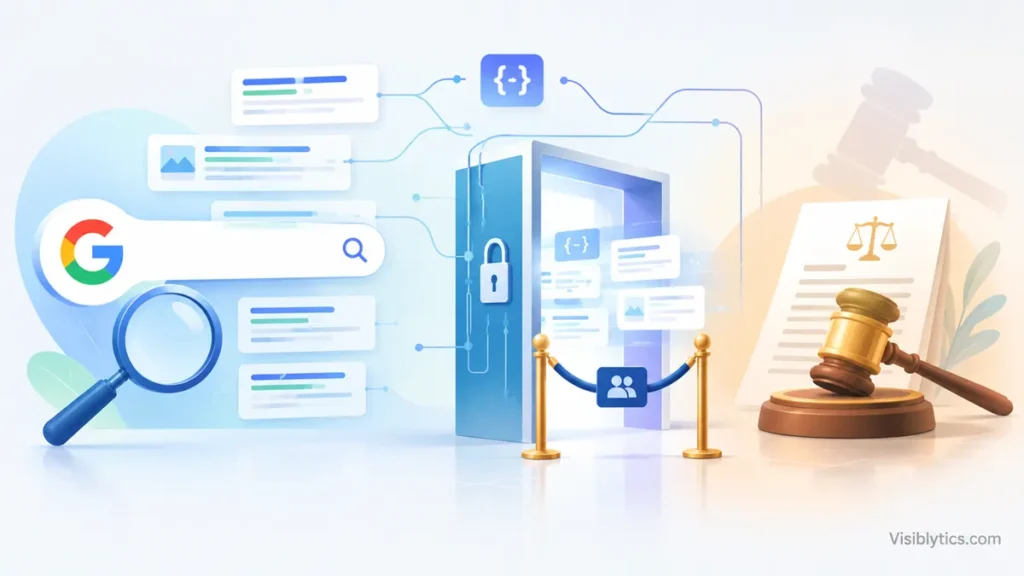
For as long as Google Search has existed, there has been a quiet industry of tools that scrape its results pages and resell the data as clean JSON: rank trackers, SERP monitors, AI answer engines, competitive intelligence platforms. None of it was ever officially sanctioned. Google never published a public search API, and everyone in SEO knew the arrangement was fragile.
That fragility became a lawsuit in December 2025, when Google sued SerpApi, one of the largest SERP-scraping providers, alleging it illegally bypassed Google’s anti-bot defenses to harvest search results at massive scale. Nine months later, that lawsuit is a shadow of what it started as, most of it has been thrown out by a federal judge, while Google has quietly published detailed documentation for something called the Web Search Service API, a partner-gated way to pull structured search results directly from Google, no scraping required.
Those two stories are connected, but not in the simple “Google sued the scrapers so it could sell you the same thing” way a lot of recent coverage implies. The real picture is more specific, and more useful if you run SEO tools, build on search data, or optimize for Knowledge Panels: Google is narrowing who gets programmatic access to its index, on multiple fronts, at the same time it’s fighting in court over what “public” search data even means.
Here’s the full picture, and what it means if your work depends on SERP data in any form.
How we got here: a year of Google closing doors
The lawsuit didn’t come out of nowhere. It’s the final step in roughly twelve months of Google deliberately making automated SERP access harder and more expensive, one restriction at a time.
September 14, 2025, Google removes the num=100 parameter. For years, anyone pulling search results programmatically could request 100 results in a single call using a URL parameter. Google quietly killed it, according to reporting from PPC Land’s timeline of the case. Overnight, getting the same 100 results took ten separate requests instead of one, roughly a tenfold increase in the cost of data collection for every rank tracker and SEO tool built on top of it.
January 2025, SearchGuard arrives. Google introduced a new JavaScript-challenge system aimed specifically at automated scraping of Search results pages, deployed the same month according to PPC Land. SerpApi and similar providers reportedly found workarounds within weeks; Google responded by tightening restrictions further, including limiting a “Light Fast API” workaround to three organic results in early October 2025.
October 22, 2025, Reddit sues first. Reddit filed suit in the Southern District of New York against SerpApi, Oxylabs, AWMProxy, and Perplexity AI, alleging its licensed content was being extracted from Google’s search results and used without authorization, largely to feed AI systems like Perplexity.
December 19, 2025, Google sues SerpApi. Google filed a 13-page complaint in the Northern District of California (case 4:25-cv-10826-YGR) under the Digital Millennium Copyright Act (DMCA), the law that prohibits circumventing technical measures designed to protect copyrighted works. Google’s central allegation was that SerpApi used automated means, disguised to look like human traffic, to bypass SearchGuard and extract search results at massive scale, with query volume Google says grew by as much as 25,000% over two years, seeking statutory damages of $200 to $2,500 per act.
SerpApi’s public response framed the suit differently. Founder and CEO Julien Khaleghy pointed out that, taken at Google’s own numbers, statutory damages under its theory would total roughly $7.06 trillion, more than the entire GDP of the United States, arguing that alone shows the law was never meant to be used this way.
The lawsuit collapsed, then Google rebuilt it smaller
This is the part that most recent coverage skips, and it matters more than the original filing.
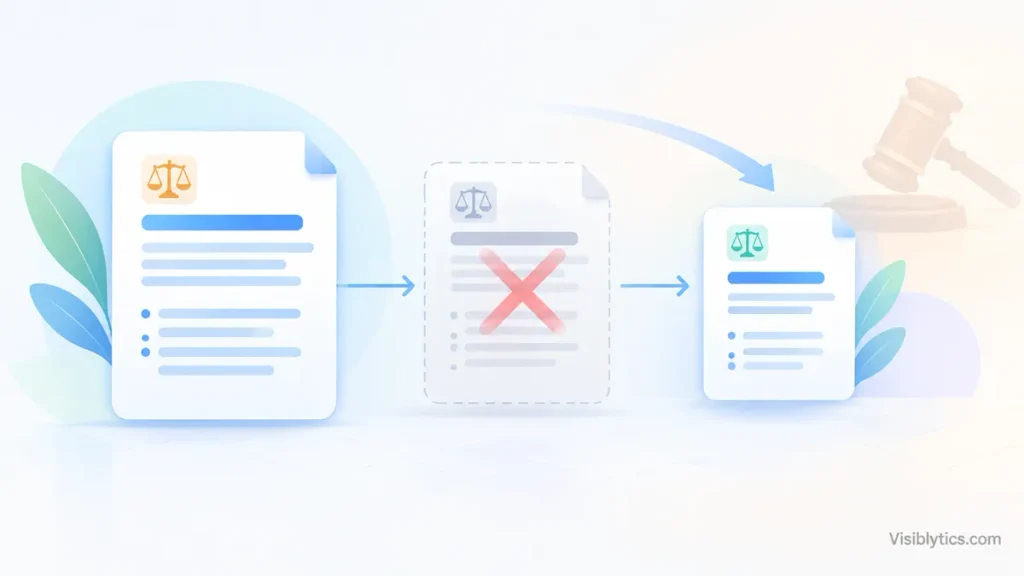
July 20, 2026, the court dismisses the entire original complaint. Judge Yvonne Gonzalez Rogers, in the Northern District of California, granted SerpApi’s motion to dismiss both of Google’s DMCA claims. The ruling split cleanly by content type. Any part of Google’s claim based on ordinary search results, the ones without copyrighted material, was dismissed permanently, with prejudice, meaning Google can never revive that theory. The part touching search results that did include copyrighted content survived only as an opportunity to try again: the court found Google hadn’t shown that SearchGuard was actually deployed with the authorization of the copyright holders whose material it was supposedly protecting. Google got 21 days to fix that gap.
Two things are easy to miss in the coverage that followed. First, the court did not buy every argument SerpApi made, it rejected SerpApi’s claim that Google lacked standing to sue under the DMCA at all, and found Google had alleged enough to support the idea that SearchGuard had, in fact, been circumvented. Second, discovery was stayed the entire time, so nothing in this case has yet reached the fact-finding stage.
August 10, 2026, Google refiles, much narrower. On the final day of its window, Google filed an amended, 15-page complaint. The theories involving Google Shopping and Google Maps, which were part of the original filing, are gone entirely. What’s left centers on licensed content appearing inside search results, specifically Knowledge Panels. Google’s new argument, according to PPC Land’s review of the filing, is that its licensing partners, Reddit among them, explicitly required Google to prevent third parties from extracting and independently commercializing their licensed content, and that SearchGuard was deployed at their request to do exactly that.
August 24 to 25, 2026, SerpApi moves to dismiss again. SerpApi’s second motion, a 23-page filing asking the court to dismiss with prejudice, argues Google has built its entire remaining case on license agreements it has never produced in court. The filing picks apart the specific examples Google cited. The only concrete pieces of content named in Google’s amended complaint are two photographs used in Knowledge Panels: one of Babe Ruth from 1921, and one of Willie Mays from 1951. Coverage from CrawlRaven notes SerpApi’s argument that the first is unambiguously in the public domain and the second is no longer under copyright, meaning the two flagship examples of “licensed content” Google is suing to protect may not be protected content at all.
September 29, 2026, a hearing on that motion is scheduled, two weeks from today, at 2:00 p.m. in Courtroom 1 of the Northern District of California.
Meanwhile, Reddit’s separate case against SerpApi and Perplexity is proceeding on its own track in the Southern District of New York, where Judge Paul Engelmayer allowed Reddit’s claims to move forward in late July 2026, a notably different outcome from Google’s case in California, decided under different legal theories (Reddit isn’t relying on the DMCA in the same way).
No injunction has been issued in either case. As of this writing, SerpApi says its service is operating normally, and Khaleghy has publicly framed each ruling in its favor as validation of an “open internet” argument.
What Google actually built: the Web Search Service API
While the lawsuit was narrowing in court, Google was quietly building the thing that made the whole dispute look, to outside observers, like a pretext.
On September 9, 2026, Google refreshed its developer documentation for the Web Search Service API. According to that documentation, it lets approved programmatic partners retrieve and display Google Search results through REST or gRPC requests, returned as structured JSON, including result titles, URLs, snippets, and corrected-query suggestions.
Getting access requires three things, per Google’s own overview page, none of which a developer can set up alone:
- An active Google Cloud project.
- An API key, created through Google Cloud Console.
- A client ID tied to a partner agreement, meaning Google has to agree to work with you first.
There’s no self-serve signup. No published pricing. No published qualification criteria. No published rate limits beyond a pageSize parameter you set yourself. Google’s own documentation doesn’t explain how a company becomes a partner in the first place, it assumes you already are one.
It’s worth being precise about what this is and isn’t. It is not a brand-new product launched in response to the lawsuit. Google had already signaled, back in January 2026, that it planned to offer full-web search results to select developers through a Programmable Search Engine announcement pointing interested parties to an interest form with almost no detail attached. What changed on September 9 wasn’t the existence of the offering, it was the documentation. Google went from a vague form to a fully specified technical contract, complete with authentication requirements and response schemas. Tellingly, neither the January announcement nor the new developer pages reference each other; Google hasn’t tied the two together publicly, and it’s SEO journalists, not Google, who have connected the dots.
The other closing door: Custom Search JSON API’s sunset
Here’s the detail that gets far less attention than the lawsuit, and arguably matters more if you run any tool that touches search data.
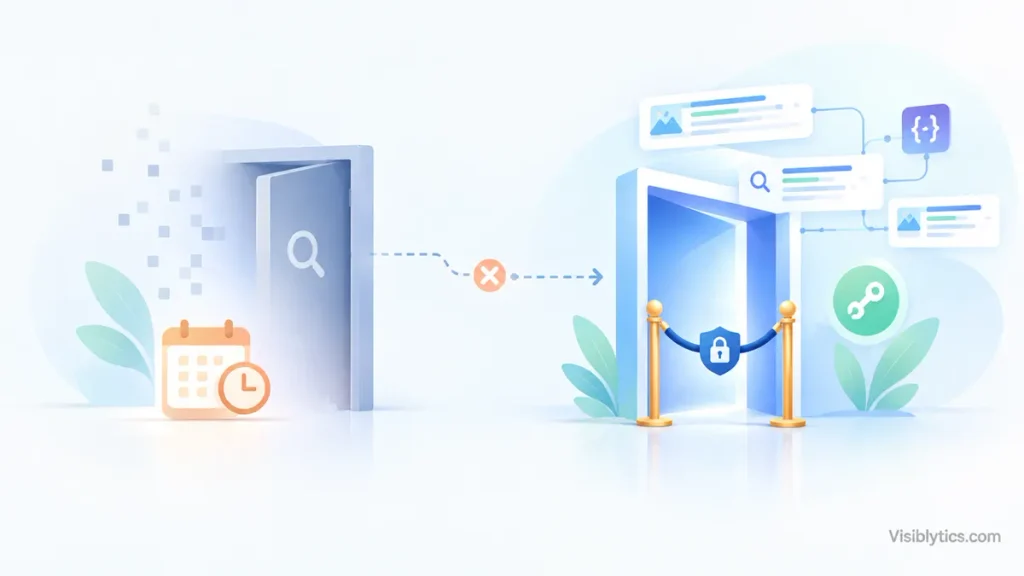
Google’s Custom Search JSON API, the closest thing to a public, self-serve search API that has existed for years, widely used for full-web search integrations in smaller tools, internal dashboards, and custom projects, is closed to new customers as of Google’s current documentation, and existing customers have until January 1, 2027 to transition off it. Google announced the shutdown quietly, through a Programmable Search Engine blog post and console notifications in January 2026.
The Web Search Service API matches the Custom Search JSON API’s full-web use case almost exactly. It performs the same kind of full web search. It’s also, unlike its predecessor, limited entirely to partners. Google’s own transition guidance points existing Custom Search customers toward Vertex AI Search for up to 50 domains, an enterprise product with different pricing and minimums, or asks them to “contact us to express interest” in the full web search solution, with no published criteria for who gets a yes.
For anyone currently building on Custom Search JSON API for full-web functionality, the practical situation right now is: your API is shutting down in under four months, and its apparent successor requires a negotiated partnership that Google hasn’t explained how to obtain. Google has not published a migration path, hasn’t said whether existing Custom Search customers get any kind of priority consideration for partner status, and hasn’t given any public timeline for when, or whether, the partner program will open more broadly.
Put plainly: self-serve programmatic access to Google’s full web index is disappearing. What replaces it is not equivalent.
Reading the two stories together, honestly
It’s tempting to collapse all of this into one clean narrative, “Google sued the scrapers so it could sell the same data itself,” but the record doesn’t quite support that as a strategy executed on schedule. The API documentation update happened on September 9, six days before this was written; the lawsuit is nine months old and has already been dismissed once. If this were a coordinated plan to shut the door and then charge admission, the door and the toll booth arrived on wildly different timelines, and the door has been repeatedly kicked back open by a federal judge.
What the two stories do share is a single underlying direction: Google is making unauthorized, no-strings access to Search data harder, more expensive, and more legally risky, on every front simultaneously: technical (SearchGuard, the num=100 removal, and, as of late August 2026, a new goto redirect layer on result links that PPC Land reported forced rank trackers into 500 to 1,000 requests to resolve a single five-page ranking), contractual (the Web Search Service API’s partner gate), and legal (the DMCA suit, however diminished). Whether or not these were planned together, they add up to the same outcome for anyone who isn’t already a Google-blessed partner: less access, at a higher cost, with more legal exposure attached to filling the gap yourself.
Whether that counts as “Google opening Search” or “Google tightening control” depends entirely on who you are. If you’re one of the companies Google eventually approves as a partner, likely a small number of well-resourced AI or search companies, this is Google finally giving you a clean, documented, legally uncomplicated way to get what you were probably already paying a scraper for. If you’re a small SEO tool, an independent rank tracker, a researcher, or a solo developer, there is currently no path in the documentation for you at all. You’re not being offered a worse deal; you’re not being offered a deal.
The Knowledge Panel angle nobody’s connecting yet
There’s a smaller thread in Google’s amended complaint that deserves more attention from anyone doing entity SEO or Knowledge Panel optimization work, because it’s a rare moment where Google is making a legal argument about what a Knowledge Panel actually is.
Google’s narrowed case now rests specifically on the idea that certain content inside Knowledge Panels, the photographs it cited, for instance, is licensed material that rights holders explicitly asked Google to protect from extraction, not incidental content Google surfaced on its own. That’s a meaningfully different characterization of Knowledge Panels than the one most SEO practitioners work with day to day. The common mental model is that panel content is assembled algorithmically from Google’s Knowledge Graph, drawing on structured data, Wikipedia, and other public signals, with the entity’s own site playing a supporting role through schema markup and sameAs signals. Google’s court filing describes at least part of that content as governed by direct licensing agreements with specific requirements attached, agreements the entity being featured in the panel isn’t necessarily a party to.
If Google’s amended theory survives the September 29 hearing, it puts a legal label on something that’s mostly been treated as a technical and editorial question: which parts of a Knowledge Panel are Google’s own aggregation, versus contractually protected content Google is obligated to guard on someone else’s behalf. For brands actively working on Knowledge Panel development and entity optimization, that distinction is worth watching, because it may eventually shape what kind of content Google is willing to pull into a panel from third-party sources versus what it sources only from parties it has direct licensing terms with.
It’s a thin thread right now. As noted above, SerpApi’s motion argues the two examples Google cited (a 1921 photo and a 1951 photo) aren’t validly copyrighted at all, which, if the court agrees, would undercut this theory before it gets any real legal weight behind it. Worth flagging as a case to watch rather than a settled implication.
What this actually means if you run SEO tools or rely on SERP data
Setting aside the legal drama, here’s the practical state of play for anyone whose work depends on structured search data:
Nothing has broken yet. No injunction has been issued against SerpApi or any other provider. Rank trackers, SERP checkers, and AI visibility tools built on scraped data are functioning as they were before any of this started, though at higher cost. Search Console data, which comes directly from Google to site owners, is unaffected by any of this; none of the disputes touch that channel.
Costs have already risen, and probably keep rising. The num=100 removal alone reportedly raised the cost of full-SERP collection roughly tenfold for tools that hadn’t adapted, and the more recent goto redirect change has pushed some rank trackers to hundreds of requests per ranking check. That happened before the lawsuit was even filed and has continued through it. If Google keeps tightening technical restrictions on unauthorized access, which the SearchGuard rollout and its subsequent hardening suggest it will, the cost trend for third-party SERP data points one direction: up.
The self-serve door is closing on a fixed date. If any part of your stack touches the Custom Search JSON API for full-web results, January 1, 2027 is a real deadline, not a hypothetical one. Google’s official transition guidance offers a site-restricted enterprise product as the closest documented alternative, not a like-for-like replacement.
The partner-only replacement isn’t available to most people, and there’s no published way to become eligible. Unless you’re already large enough to be in conversation with Google’s partnerships team, or you become one of an unknown, unpublished number of approved partners, the Web Search Service API isn’t a plan you can build around today. It’s worth registering interest through whatever channel Google eventually opens, but not worth designing your roadmap around access you don’t have and can’t apply for.
The legal ground is genuinely unsettled, in both directions. SerpApi has real momentum, having gotten Google’s entire original complaint thrown out and forced Google into a much narrower position. But it hasn’t won outright, the court left the door open for a revised claim, and a second dismissal motion is pending judgment as of this writing. Building long-term infrastructure on the assumption that scraping-based SERP tools are legally settled and safe would be premature; so would assuming they’re about to be shut down.
What happens next
The single most consequential date on the calendar is September 29, 2026, the hearing on SerpApi’s motion to dismiss Google’s amended complaint. Three outcomes are plausible: the court dismisses again, likely with prejudice this time given it’s Google’s second attempt, effectively ending the DMCA claims; the court lets the narrowed Knowledge Panel-licensing theory proceed to discovery, which would be the first time either side has to produce real evidence rather than argue pleadings; or something narrower still survives while parts get trimmed again.
Separately, watch for whether Google says anything concrete about a migration path for Custom Search JSON API users before that API’s January 2027 shutdown. Silence on that point, this close to the deadline, is itself informative.
We’ll update this piece as both threads develop. If you’re building anything that depends on programmatic access to Google Search results, a rank tracker, an AI visibility checker, an entity monitoring tool, the two dates to hold in your head are September 29, 2026, and January 1, 2027. Everything else right now is positioning.