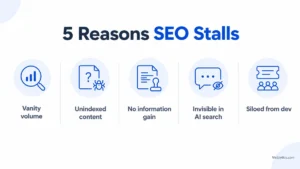
Your team has published twice a week for nine months. The writing is solid, the editorial calendar is full, and the organic line in your analytics is still flat. The instinct at this point is to blame the writing, the publishing frequency, or Google. In most cases the failure happened earlier, before a single draft was started: someone chose the wrong queries.
This article diagnoses four structural flaws in how most blog keyword research is done, shows how to test your own content library against each one, and gives you a scoring matrix you can use this week to re-prioritize what you publish next. It stays on organic search keyword strategy only, so you will not find channel advice here.
The Content Hamster Wheel: Publishing Consistently to Zero Organic Visitors
The hamster wheel looks like this: every post is reasonable in isolation, none of them is wrong in an obvious way, and collectively they produce almost no qualified organic visits. Effort stays high and returns stay flat, so the usual response is to publish more, which repeats the same selection error at higher volume.
Before you blame keyword research, rule out the failure that looks identical from the outside. Open Google Search Console, go to the Pages report, and check whether your recent posts are actually indexed. A post that Google has not indexed cannot rank for anything, and that is a crawl and indexation problem, not a keyword problem. If your posts are indexed but earn few or no impressions in the Performance report, keep reading: you are probably dealing with one or more of the four flaws below.
One diagnostic worth running right now: export your last 12 months of Search Console queries and sort your posts by impressions. If your top ten posts by impressions are not the ten posts you would most want a buyer to find, your research process is selecting for the wrong thing. For a complete walkthrough of the research process itself, our complete keyword research guide covers it end to end. This article focuses on where that process usually breaks.
Flaw 1: The Volume Trap (Targeting KD 85 Keywords With a Fresh Domain)
The most common research workflow is to open Ahrefs or Semrush, enter a seed topic, and sort the results by search volume. The top of that list is always the most competitive territory in the niche, and a young domain is being asked to compete there with a handful of referring domains.
Keyword difficulty scores are tool-specific estimates, not Google metrics. To my understanding, Ahrefs’ KD is driven mainly by the number of referring domains pointing to the pages currently ranking in the top 10, but you should verify the exact methodology in Ahrefs’ current documentation, and Semrush uses its own separate calculation. The practical point holds regardless of the formula: a keyword scored at KD 85 is one where the pages ranking today sit on large, established link profiles. A fresh domain publishing a well-written post against that SERP is not in a fair contest.
How to test whether you have this problem:
- List the primary keyword of your last 20 posts and pull volume and KD for each in Ahrefs or Semrush.
- Compare KD against your own domain’s strength (for example, its referring domain count in the same tool).
- For each keyword, open the live SERP and count how many ranking sites look comparable to yours in size and authority. If the answer is zero for most of your list, you have targeted a tier of competition you cannot yet reach.
A working rule: choose keywords where you can find at least a few comparable-authority sites already ranking in the top 10. This is my own heuristic, not an industry standard or a verified threshold, but it replaces the question “how big is this keyword?” with the better question “has a site like mine ever won here?”
The fix is not to avoid high-volume terms forever. It is to sequence them. Win the winnable queries first, build links and topical coverage around them, and approach the contested terms once your domain can plausibly compete.
Flaw 2: The Intent Mismatch (Creating Blog Content for Product/Transactional Queries)
The second flaw is subtler because the keyword can be perfectly winnable and still be the wrong target. If Google’s results for a query are dominated by product pages, category pages, pricing pages, or tool homepages, then Google has concluded that searchers want to transact, and a blog post is the wrong page type to offer.
This happens constantly with commercial head terms. A post targeting a broad software category name competes against vendor homepages. A post targeting “best [category] for [specific use case]” competes against comparison articles, which is a format a blog can actually win. The keyword phrases look similar and the SERPs are completely different.
The 60-second SERP intent check (do this before approving any brief):
- Page type: what are the top results, blog posts, product pages, tools, forums, or category pages?
- Format: are they guides, listicles, comparisons, templates, or calculators?
- Angle: are they written for beginners, for evaluators, or for people ready to buy?
If your planned post does not match the dominant page type and format, either change the asset you plan to build or pick a different keyword. A blog post cannot out-optimize a SERP that has decided it wants a product page.
There is a mirror-image problem as well: queries with clean informational intent and large volume that attract readers with no commercial relevance to you. Traffic from those queries inflates your sessions without feeding your pipeline. For the full breakdown of intent categories and how to assign them, see our search intent guide.
Flaw 3: Neglecting Semantic Entities in Favor of Isolated Keyword Strings
A keyword string treats a page as a match for one phrase. In practice, pages that rank well for a competitive query tend to cover the cluster of related concepts a knowledgeable author would mention without prompting. A post about fixing duplicate URLs that never mentions canonical tags, redirects, or Search Console reads as incomplete to both readers and ranking systems. I cannot tell you precisely how Google weighs this, and anyone who claims to know the exact mechanism is overstating what is publicly documented, but the pattern is consistent enough to build into your process.
How to build the concept list for any target query:
- Open the top five to eight ranking pages and note the subtopics, terms, and tools that appear on most of them.
- Check the “People also ask” box and related searches for the same query to find sub-questions that recur.
- If you already rank for adjacent queries, pull the actual queries from Search Console for those pages. These show the language your audience uses.
- Turn the overlap into a required-coverage list in the brief, and add what the top results leave out.
That last step is where differentiation comes from. Covering the common subtopics gets you to parity. Adding something the top results lack, such as original data, a framework, or a worked example, gives a ranking system a reason to prefer your page over a near-duplicate of the existing results.
Flaw 4: Missing Topic Clusters (Publishing Random One-Off Articles With Zero Authority)
A blog of unrelated one-off posts spreads topical signal across twenty subjects and builds depth in none. A competitor with a smaller number of posts organized around a single subject often outperforms it, because every page reinforces the others through coverage and internal links.
A cluster has a simple structure:
- One commercial anchor page that targets the highest-intent query in the topic and is the page you most want to rank.
- Five to ten supporting posts (my rough working range, adjust to the topic) that each target a distinct sub-question a buyer asks while evaluating.
- Deliberate internal links from every supporting post to the anchor and to its closest siblings, with descriptive anchor text.
The common failure is a calendar built from brainstorms and tool exports with no cluster logic, so posts get written wherever the topic list happens to point that week. The fix is to decide the clusters first and then assign every planned post to one, rejecting any idea that belongs to no cluster. If your supporting content already exists but links nowhere, an on-page review focused on internal linking and page structure is usually the quickest gain, and a freelance on-page SEO expert can work through that audit alongside the keyword mapping.
How Professional Keyword Mapping Transforms Content ROI
Keyword mapping is the discipline that makes the four fixes above stick. It assigns each target query to exactly one URL, records the intent and page type that URL should have, and prevents two pages from competing for the same query. It turns research from a spreadsheet of ideas into an operating plan.
The prioritization scoring matrix (Volume x Intent x Difficulty)
Use this to rank candidate keywords before they enter the calendar. Score each keyword on three 1 to 5 scales:
| Factor | Score 1 | Score 3 | Score 5 |
|---|---|---|---|
| Volume | Very low or near zero in tools | Moderate for your niche | High for your niche |
| Intent | Purely informational, no link to what you sell | Evaluation-stage, relevant to a purchase decision | Directly tied to buying, switching, or shortlisting |
| Difficulty | Comparable-authority sites already rank easily | Mixed SERP with some reachable competitors | Dominated by sites far stronger than yours |
Priority score = (Volume x Intent) ÷ Difficulty
Gate rule: any keyword with an Intent score of 2 or lower is excluded regardless of its priority score, unless it is a deliberate supporting post inside a cluster. This stops high-volume, low-relevance terms from outranking the queries that can actually produce pipeline.
The example below uses a hypothetical B2B project management product. All keywords and scores are invented for illustration and are not tool data. Your scores should come from your own Ahrefs or Semrush pulls and a live SERP review.
| Keyword (illustrative) | Volume | Intent | Difficulty | Priority | Decision |
|---|---|---|---|---|---|
| project management software for construction subcontractors | 2 | 5 | 2 | 5.00 | Publish first |
| construction submittal tracking template | 2 | 4 | 2 | 4.00 | Publish, cluster support |
| asana alternative for agencies | 3 | 5 | 4 | 3.75 | Publish, build links first |
| how to run a project retrospective | 4 | 2 | 3 | 2.67 | Gated out (intent 2) |
| project management software | 5 | 2 | 5 | 2.00 | Gated out (intent 2) |
Notice what the matrix does: the two highest-volume terms land at the bottom, and the two smallest-volume terms land at the top. That ordering is the entire point.
Turning the scores into a keyword map
A usable map has one row per URL with these columns: primary keyword, target URL, intent, expected page type, cluster, funnel stage, and status (planned, live, needs refresh). Build the first version in three passes:
- Existing pages: crawl your site with Screaming Frog to export every URL’s title and H1, then pull the queries each URL already earns impressions for in Search Console. Assign each URL its best-fit primary keyword.
- Conflicts: wherever two URLs target the same query, flag them. This is the same internal-competition problem covered in our keyword cannibalization material, and it needs a decision before any new content is published.
- New content: add candidate keywords from your scoring matrix, assigned to a cluster, one query per URL.
For help choosing the research tools behind this process, see our keyword research tools comparison. A mapped plan is also the foundation of our Visiblytics intent-driven keyword mapping approach, where each query is validated against the live SERP before it reaches a brief.
Hiring a Keyword Research Specialist vs. Relying on Uncurated Tool Dumps
The alternative to a mapped plan is the tool dump: an export of thousands of rows, filtered by volume, handed to writers as a topic list. It is fast and cheap to produce, and it reliably recreates all four flaws above. The difference between a dump and a specialist’s deliverable is curation: judgment about which queries to ignore, which to sequence, and which belong together.
If you decide to bring in outside help, a freelance keyword research specialist to build a traffic-generating content strategy should deliver more than a longer list. Look for these outputs:
- A keyword map with one query per URL and cluster assignments, not a raw export.
- Intent validation documented per keyword from the live SERP, including the page type that is winning.
- A scored priority list with the method visible, so your team can re-score new ideas without the specialist.
- A gap analysis against your existing content, including conflicts to resolve.
- Briefs that include required-coverage lists, not just a target phrase.
Vetting questions to ask any candidate:
- How do you decide a keyword is winnable for my domain specifically, and what do you check beyond a difficulty score?
- Show me a past deliverable (redacted) that contains no raw tool export.
- How do you handle a high-volume keyword where the SERP shows product pages?
- How do you keep new content from cannibalizing existing pages?
- What will I be able to do independently after the engagement ends?
A candidate who answers question 1 with “we look at KD and volume” has described the volume trap, not a way out of it.
If your blog is stuck on the hamster wheel, you do not need to publish more. You need to publish different things, selected through a process that tests every query against intent, difficulty, and your existing content before a writer is briefed. Start with the scoring matrix above, run it on your current calendar, and see how many of your planned posts survive.