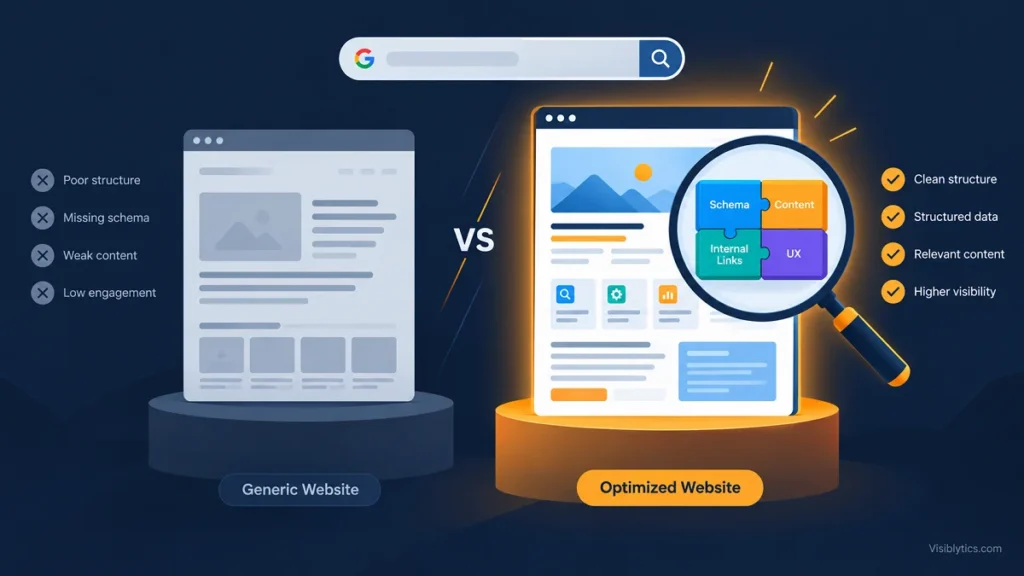
You open the SERP for your most valuable query and the result above you looks worse than yours. The copy is thinner, the design is older, and the site is one you have barely heard of. Your page took weeks to write and sits at position 7, while theirs holds position 3.
The reflex diagnosis is “they have more backlinks.” Sometimes that is true. But it is also the one explanation you cannot fix this quarter, which makes it a convenient place to stop looking. This article covers the explanations you can verify and change yourself: how the page is structured, what it adds that others do not, whether it answers the query Google thinks is being asked, and what surrounds it on your site.
The Ranking Enigma: When Inferior Content Outranks You on Google
“Inferior” is your judgement. Google’s systems compare pages against a specific query, and that comparison is not the same as editorial quality. A page can be better written and still lose because it answers a slightly different question, buries its answer, or sits alone on a site with no supporting coverage.
Before you change anything, run a quick triage to decide whether the gap is plausibly on-page at all:
- Pull referring domains for both URLs in Ahrefs or Semrush. If their page has far stronger link support, part of the gap is off-page, and the rest of this article will only explain the remainder.
- If link profiles are comparable, or yours is stronger, the on-page differences below are the most likely lever.
- Check whether the query is partly navigational. If the competitor is the brand people are looking for, brand demand explains some of the position, and no edit will replicate it.
One honest caveat: Google does not publish ranking weights, so any outside diagnosis is an informed hypothesis, not proof. Treat every finding below as something to test, change, and measure.
The On-Page Gap Analysis: What Google Sees That You Don’t
Structural Clarity: Heading Hierarchy and Direct Answer Framing
Open the top three results and extract their heading outlines. In Screaming Frog, a custom extraction on H2 and H3 elements gives you this for every competitor URL in one crawl. For a quick manual check, Chrome DevTools works too. Then compare each outline with your own.
Patterns that commonly separate the page that wins from the page that loses:
- The core question is answered within the first screen, not after several hundred words of context.
- H2s mirror the sub-questions searchers actually ask, rather than clever labels.
- Lists, tables, or step sequences appear where the query implies a comparison or a process.
This is also where snippet ownership gets decided. If the competitor holds a featured snippet or an AI Overview citation for the query, study the paragraph or table it was taken from: its length, its position under the heading, and how self-contained it is. Self-contained, directly phrased answers appear easier for a search system to lift than answers that depend on the surrounding paragraphs. I am not certain exactly how Google selects them, so treat this as an observed pattern to verify against your own SERPs.
Information Gain: Original Data and Proprietary Frameworks vs. Rehashed Advice
Run a simple test. Take your page and highlight every claim that appears, in substance, on at least three of the current top five results. What remains unhighlighted is your information gain: original data, a proprietary framework, a first-hand example, a calculation, or a tool.
If nearly everything is highlighted, your page is a well-written summary of the SERP, and a competitor with one original table or worked example gives a ranking system a reason to prefer them. A note on certainty: “information gain” comes from Google patent literature, and I am not certain how, or whether, it works as a direct ranking signal. Use it as an editorial test, not a confirmed factor.
Things that count as real additions:
- Your own pricing data or benchmarks drawn from client or product data
- A decision framework with explicit criteria
- Annotated screenshots of a real process
- Expert commentary from a named author with a verifiable background
Search Intent Precision: Did You Give a Guide When Google Wanted a Tool?
Look at the shape of the results, not only the text. If page one is dominated by calculators, comparison tables, or product listings and you published a 3,000-word essay, the format mismatch can outweigh content quality. The reverse happens too: a sales-style page competing against a SERP of explanatory guides.
Classify each top-ten result by format (guide, listicle, tool, category page, comparison, video) and note the majority. If your format is in the minority, that is your first fix. Our search intent guide covers the intent categories in depth. The practical test here is simpler: if your page’s format does not match the majority format, copy polish will not close the gap.
Topical Depth vs. Single-Page Excellence: The Surrounding Cluster Effect
A competitor can outrank a better single page because that page is one of many. Check what sits around it. Search site:competitor.com plus the core topic and count how many distinct pages address sub-topics, comparisons, and use cases. Then do the same for your own site.
Next, check how your page is wired in. In Screaming Frog, the Inlinks tab shows how many internal links point to each URL and with what anchor text. A page you consider critical with two internal links, both from a footer or tag archive, signals very little. A competitor that links its key page from a dozen related articles with descriptive anchors is telling Google much more clearly which URL owns the topic.
Two fixes usually come first:
- Add contextual internal links from your strongest, most related pages to the underperforming one.
- Fill the two or three most obvious sub-topic gaps with supporting pages.
For the complete restructuring and refresh workflow, see our full content optimisation guide.
The Competitive On-Page Teardown Matrix
Copy this table into a spreadsheet. Fill one row per factor for your page and each of the top three competitors, and score the gap as Low, Medium, or High.
| Factor | What to check | Tool | Your page | Competitor | Gap |
|---|---|---|---|---|---|
| Intent and format match | Majority SERP format vs. your format | Manual SERP review | |||
| Answer position | Words before the direct answer appears | Manual review, DevTools | |||
| Heading structure | H2/H3 outline mirrors real sub-questions | Screaming Frog | |||
| Snippet ownership | Who holds the featured snippet or AI citation | Semrush, Ahrefs, manual | |||
| Information gain | Original data, frameworks, examples | Manual highlight test | |||
| Topical coverage | Supporting pages on sub-topics | site: search, Ahrefs | |||
| Internal links in | Count and anchor quality pointing to the URL | Screaming Frog | |||
| Title and snippet | Query-matching title, clear meta description | Google Search Console | |||
| Structured data | Schema types present and valid | Rich Results Test | |||
| Experience signals | Named author, credentials, first-hand evidence | Manual review | |||
| Page experience | Core Web Vitals field data | PageSpeed Insights |
Read the matrix by clustering the High scores. A single High on intent match outweighs five Mediums elsewhere, so fix that first.
How to Close On-Page Deficits and Take Back the Position
Order matters. Work through the fixes in this sequence:
- Intent and format first. If the page type is wrong, restructure or replace it rather than refining it.
- Restructure. Move the answer to the top, rewrite H2s as the sub-questions searchers ask, and add the table or list the SERP expects.
- Add information gain. One original asset beats ten paragraphs of rewording.
- Rewire internal links and publish the missing cluster pages.
- Refresh the title and meta description last, using Google Search Console to see which queries you already appear for and what your click-through rate is.
Two rules keep the work measurable. First, change a page in one logged batch and note the date, so you can compare query-level average position and clicks in Search Console before and after. Allow several weeks for recrawling and re-evaluation; I am not certain of a reliable timeframe, so check how quickly Google recrawls your URLs with the URL Inspection tool. Second, matching a competitor’s structure is not the same as copying its text. Close the gap with your own data, examples, and wording.
When the Gap Isn’t On-Page
Some gaps will not close with edits. If the matrix shows only Low gaps, but the competitor has far stronger link support, an established brand people search for by name, or much deeper domain trust, the on-page work will help but may not be enough alone. Knowing this early saves months of rewriting a page that was never the problem. In those cases, run the on-page fixes in parallel with a realistic plan for earning authority, rather than expecting edits to carry the whole result.
Partnering with an On-Page SEO Specialist to Audit and Leapfrog Competitor SERPs
Running this teardown on one URL against three competitors takes a few focused hours. Running it across fifty commercial URLs, prioritising by revenue impact, and then implementing the changes is a program of work. That is where a freelance on-page SEO specialist to close the competitive gap fits: someone who runs the matrix, ranks the fixes by pipeline value, and ships the edits rather than handing you a report.
If the work needs to continue across your whole site rather than as a one-off project, an ongoing SEO retainer keeps the same teardown-and-fix cycle running month after month.