
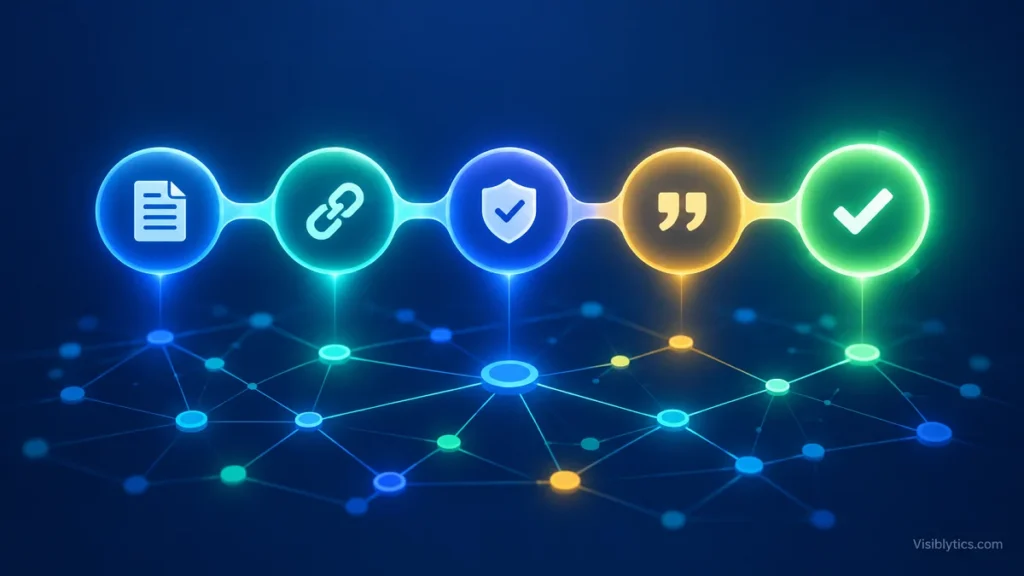
The Knowledge Panel guide introduces the five-signal eligibility chain and explains the sequence they follow. This guide goes deeper: what each signal actually looks like in practice, what strong versus weak looks like for each one, how to know whether your entity has it, and what to do if it is missing.
A reminder before going further: these are signals, not ranking factors. They are not a formula. Building all five does not guarantee a knowledge panel, and I cannot tell you the exact weighting Google assigns to each because Google has not published that. What the signal chain reflects is how knowledge graph confidence is built, and knowledge panel eligibility is a downstream consequence of that confidence reaching a sufficient threshold.
Signal 1: Clear Entity Identity
The question this signal answers: Can Google identify exactly which entity this is, without ambiguity?
Entity identity is the prerequisite for everything else. A knowledge panel cannot appear for an entity Google cannot confidently identify. Before any other signal matters, the entity needs to be resolvable to a single, unambiguous node in the knowledge graph.
What strong entity identity looks like:
One exact name used consistently everywhere. “Visiblytics” on the website, “Visiblytics” in schema, “Visiblytics” on LinkedIn, “Visiblytics” on Wikidata. No variants. A clear entity type declared in schema (@type: ProfessionalService rather than the generic @type: Organization). A one to two sentence factual description that is identical or nearly identical across the entity homepage, schema, and Wikidata. A founding date that is consistent across all sources. Named key people who are themselves clearly connected to the entity.
What weak entity identity looks like:
The brand name appears as “Visiblytics,” “Visiblytics SEO,” and “Visiblytics.com” across different platforms. No founding date anywhere. The description on the website says “AI Visibility platform” while LinkedIn says “SEO agency.” The About page is marketing copy with no factual entity information. Schema uses the generic Organization type with only name and URL.
How to check it:
Search your exact entity name in Google. Does Google show entity-aware results: a description snippet, structured entity information, any sign it knows what this entity is? Or does it return generic link results? Search your name across your website, your schema, your Wikidata entry, and your social profiles. List every version of your name that appears. If there is more than one version, entity identity is weak.
What to do:
Decide on the canonical name and write it down. Update every surface to use that exact name. Build or complete an entity homepage that states all core attributes plainly. Add Organization or Person schema with all required properties. The Entity SEO guide covers entity definition in full.
Signal 2: Consistent Information
The question this signal answers: Do all sources say the same thing about this entity?
Consistent information is what allows signals from multiple sources to corroborate each other rather than conflict. When sources agree, the knowledge graph increases its confidence in each attributed fact. When they conflict, the knowledge graph runs reconciliation and stores the entity with lower confidence until the conflict resolves.
What strong consistency looks like:
Every source that mentions your entity uses the same name, the same founding date, the same description language, and the same attribution for key people. Your entity homepage, schema, Wikidata, LinkedIn, Twitter/X, and press mentions all reflect the same version of reality. When something changes (a role, a URL, a founding date correction), all sources are updated within the same week.
What weak consistency looks like:
Your schema says the company was founded in 2024 but a press mention from early in the year says 2023. Your LinkedIn company description says “SEO agency” but your website says “AI Visibility platform.” Your About page calls the founder “Suraj Saini” but an old directory listing calls him “S. Saini.” Your sameAs in schema points to a LinkedIn profile that uses a slightly different company name.
How to check it:
Create a simple grid. Rows: entity name, founding date, description, founder name, website URL. Columns: entity homepage, schema, Wikidata, LinkedIn, Twitter/X, and any notable press mentions. Fill in what each source currently says. Every cell that does not match the others in its row is a consistency failure.
What to do:
Fix from highest-authority source downward. Your entity homepage and schema are the anchors. Once those are correct, update Wikidata, then social profiles, then directories. Do not fix only one source while leaving others inconsistent. The Entity Consistency guide covers the full process.
Signal 3: Structured Data
The question this signal answers: Has this entity declared its attributes and relationships in a format the knowledge graph can process directly?
Structured data is the machine-readable layer that converts your entity page content into explicit declarations. The knowledge graph can infer some entity information from prose, but inference is less reliable than explicit declaration. Schema removes the inference step for the attributes and relationships it covers.
What strong structured data looks like:
Organization schema on the entity homepage with name, url, logo, description, foundingDate, founder (nested Person with URL), knowsAbout, and sameAs references to all external profiles including Wikidata. Person schema on every author page with name, jobTitle, worksFor (nested Organization with URL), knowsAbout, hasCredential (for verifiable certifications), and sameAs. Article schema on every published piece of content with author (URL to author page), publisher (Organization with name and URL), datePublished, and about. Zero errors in Google’s rich results test.
What weak structured data looks like:
Schema exists but is missing key properties: no foundingDate, no knowsAbout, no sameAs references. The sameAs array is empty or points to profiles that use a different entity name. Article schema exists but the author property is a text string rather than a Person object with a URL. Person schema has no worksFor. The schema validates without errors but states only name and URL with nothing else.
How to check it:
Run your entity homepage, all author pages, and a sample of five articles through the Structured Data Testing Tool. Check for errors first, then check for completeness. A schema block with no errors but missing foundingDate, founder, knowsAbout, and sameAs is technically valid but practically incomplete.
What to do:
Use the Schema Markup Generator to rebuild schema completely rather than patching individual properties. Start with Organization schema on the entity homepage, then Person schema on author pages, then Article schema on content. The Schema and Knowledge Graphs guide covers which properties do the most knowledge graph work and why.
Signal 4: Authoritative Mentions
The question this signal answers: Have independent, credible sources confirmed that this entity exists and is recognized in its stated domain?
Authoritative mentions are the external corroboration layer. No amount of on-site work can replace this signal because it is definitionally about sources outside your own domain. A knowledge graph that has only self-asserted signals, only your own site and schema, is working with unverified claims. Authoritative mentions provide the independent verification that converts claims into confirmed facts.
What strong authoritative mentions look like:
A Wikidata entry with accurate statements and references. A Wikipedia article (where notability requirements are met). Coverage in credible publications that names the entity, describes what it does, and places it in a professional context. Presence in recognized industry directories with consistent entity information. Co-citations alongside recognized entities in the same topic area. The entity’s research or frameworks cited by other credible sources.
What weak authoritative mentions look like:
No Wikidata entry. No press coverage mentioning the entity by name. Directory presences limited to generic local business aggregators with minimal authority. Social media mentions from personal accounts rather than institutional sources. The only external mentions are self-submitted to low-authority directories.
How to check it:
Search your entity name in Google and review the top 30 results. How many are from independent, credible sources that are not your own properties? Check Wikidata directly. Search your entity name on Wikidata.org. Note whether any credible publications have covered you, and whether those mentions use your canonical entity name and describe your expertise accurately.
What to do:
Create a Wikidata entry if one does not exist. This is the single highest-priority authoritative mention action available to most businesses. Then pursue Digital PR: credible press coverage that names the entity correctly and describes its expertise. The Digital PR guide covers how to structure outreach to maximize entity corroboration value from coverage. The Wikidata for SEO guide covers the creation process.
The threshold question:
There is no verified minimum number of mentions that triggers knowledge panel eligibility. What the signal requires is sufficient independent corroboration for the knowledge graph to be confident that this entity is real, correctly described, and recognized beyond your own domain. For most business entities, three to five quality mentions from credible sources is a meaningful starting point. Quality matters more than quantity: one mention in a recognized industry publication is worth more than twenty mentions in low-authority directories.
Signal 5: Strong Entity Relationships
The question this signal answers: Is this entity connected to the broader knowledge graph network, or is it an isolated node?
Entity relationships are what make a knowledge graph navigable. An entity with strong relationships is reachable through multiple traversal paths, appears in topic-relevant searches, and is placed in a coherent context within the knowledge graph network. An isolated entity has no connections to leverage and no network position.
What strong entity relationships look like:
The founder-to-organization relationship is stated in both directions: Organization schema includes the founder with a URL, Person schema includes worksFor pointing back to the organization. Author pages link to published content, and published content links back to author pages. The organization entity is connected to recognized topic areas through consistent content coverage and knowsAbout schema. External sources state the same entity relationships, corroborating what the schema declares. The entity appears in co-citations alongside recognized entities in its topic area.
What weak entity relationships look like:
Organization schema names a founder but the founder’s author page has no worksFor pointing back. Content is published under bylines that do not link to author pages. The organization entity has no topical associations in schema or content. sameAs references exist but point to profiles that do not state the same organizational relationships. The entity appears in no co-citations with recognized peers.
How to check it:
Check the bidirectionality of your most important relationships. Does your Organization schema include a founder with a URL? Does that URL (the author page) include worksFor pointing back to the organization? Do your published articles have bylines that link to author pages? Do those author pages link to published content? Does your Wikidata entry state the same foundational relationships as your schema?
What to do:
Implement bidirectional schema for all key relationships. Audit internal linking between entity pages and content. Build topical relationships through sustained content coverage combined with knowsAbout schema. Pursue co-citations with recognized entities in your field. The Entity Relationships guide and the Entity Relationships in Knowledge Graphs guide cover the full mechanics.
How the Signals Interact
The five signals build on each other in the order presented, but they also interact in ways worth understanding.
Identity amplifies everything else. Consistent information that describes an ambiguous entity produces lower confidence than the same consistency applied to a clearly identified entity. Structured data that declares attributes for an unclear entity is less useful than the same schema for a well-defined one. Every signal downstream of identity is strengthened or weakened by how clearly the identity layer is established.
Consistency is the multiplier. When a consistent identity signal appears across five independent sources, those five corroborate each other. When they conflict, they partially cancel each other out. Consistency is what determines whether additional authoritative mentions add to knowledge graph confidence or merely introduce new conflicts.
Structured data and authoritative mentions work at different layers. Schema works at the declaration layer: it tells the knowledge graph what the entity claims about itself. Authoritative mentions work at the verification layer: they tell the knowledge graph what independent sources confirm about the entity. A brand that has excellent schema but no external mentions is unverified. A brand with strong press coverage but no schema is unstructured. The combination is what produces reliable knowledge graph confidence.
Relationships are the final connector. An entity can have strong identity, consistent information, solid schema, and good press coverage, and still be effectively isolated in the knowledge graph if its relationships are missing or one-directional. Relationships are what place the entity inside a network rather than leaving it as a standalone point.
What Eligibility Actually Looks Like in Practice
Two entities. Both legitimate businesses. Both have websites, social profiles, and some press coverage.
Entity A has a clear canonical name used identically everywhere. Its entity homepage states founding date, founder name, and a factual description. Organization schema covers all required properties including sameAs to a Wikidata entry and LinkedIn. The Wikidata entry has accurate statements with references. The founder’s author page has complete Person schema with worksFor pointing back to the organization. Five articles in credible industry publications mention the entity by its canonical name and describe its expertise. Those mentions appear in topically relevant context alongside recognized peers.
Entity B uses its name in three variations across different platforms. Its About page is marketing copy. Schema exists but covers only name and URL. No Wikidata entry. Two press mentions exist but use a variant of the name and describe the entity in generic terms. No author pages. No Article schema.
Entity A is a strong knowledge panel candidate. Entity B is not, not because it is less legitimate as a business, but because its entity signals give the knowledge graph nothing reliable to work with.
The gap between A and B is the work of eligibility signal building. None of it requires being famous. All of it requires being deliberate.
For the broader knowledge panel framework including how panels work, who qualifies, and how to manage them once they appear, the Knowledge Panel guide covers the complete picture.